Hadith of the Day

Hadith of the Day

Hadith of the Day

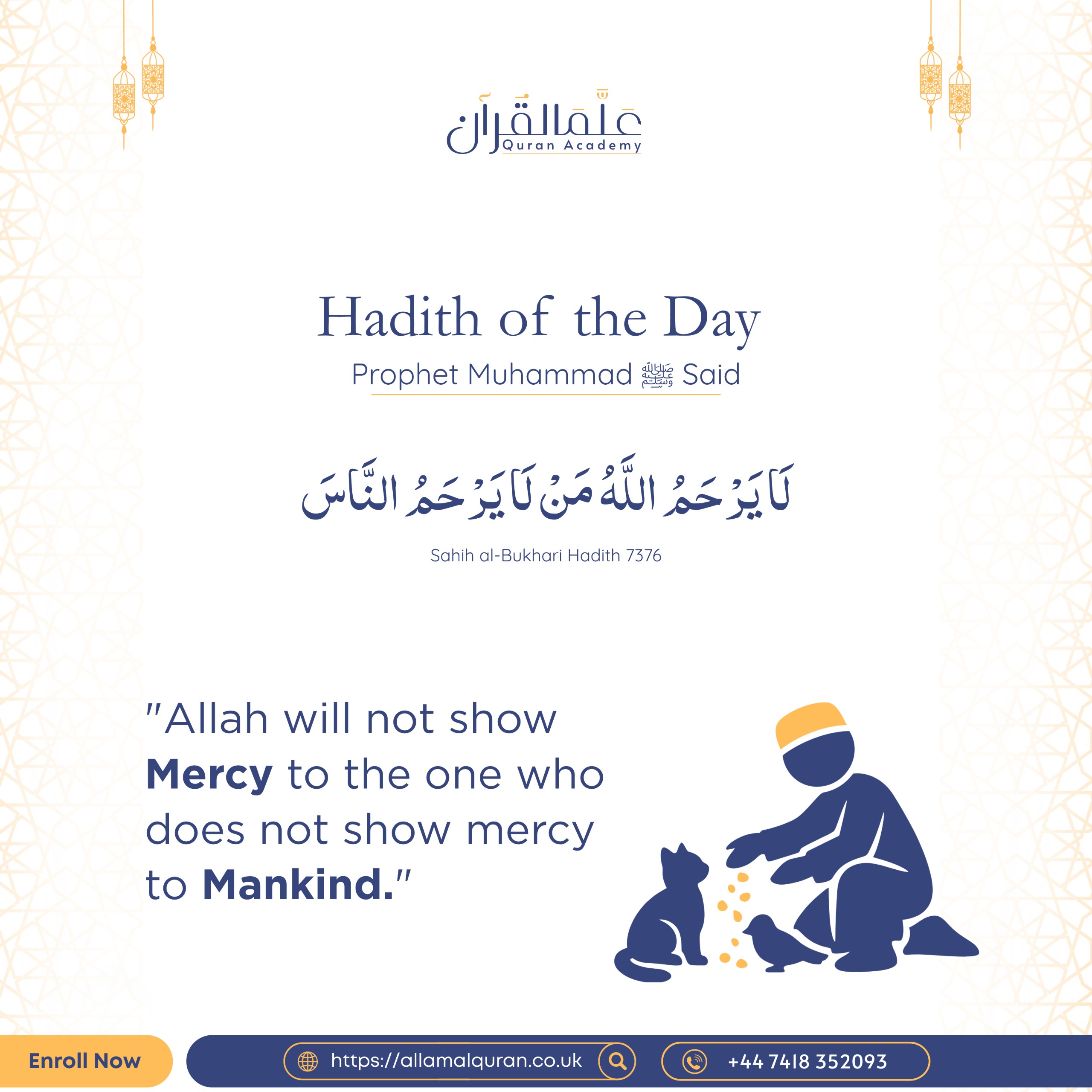
Prophet Muhammad ﷺ Said
لَا يَرْحَمُ اللَّهُ مَنْ لَا يَرْحَمُ النَّاسَ
Sahih al-Bukhari Hadith 7376
"Allah will not show Mercy to the one who does not show mercy to Mankind."

This profound Hadith encapsulates a universal principle of Islamic ethics: divine mercy is intrinsically linked to human compassion. The Prophet Muhammad (peace be upon him) reminds us that our treatment of fellow human beings is a direct reflection of our relationship with the Creator. Mercy is not merely an abstract attribute of Allah; it is a moral obligation that every believer must embody in daily interactions.

The Essence of Mercy in Islam

Mercy (rahmah) is one of Allah's most emphasized attributes, appearing at the beginning of every chapter of the Quran except one: "In the name of Allah, the Most Gracious, the Most Merciful." The Hadith quoted above elevates this divine attribute to a human standard. When the Prophet says that Allah will not show mercy to one who is not merciful to people, he establishes a clear cause-and-effect relationship. It is not a conditional threat but a spiritual reality: mercy is a reflection of divine light, and those who block it from reaching others also block it from reaching themselves.

Scholars have interpreted "mercy to mankind" as encompassing all forms of kindness, compassion, forgiveness, and assistance. It includes feeding the hungry, comforting the distressed, forgiving those who wrong us, and even smiling at a fellow Muslim. Imam al-Bukhari included this Hadith in his Sahih to remind believers that faith is incomplete without practical compassion. The wording "mankind" (an-nas) is universal, indicating that mercy extends beyond Muslims to all of humanity, regardless of faith, race, or status.

Practical Applications in Daily Life

Mercy manifests in countless ways. In family life, it means patience with children, kindness to parents, and forbearance with a spouse. In the workplace, it translates into honesty, fairness, and helping colleagues. In the community, it means visiting the sick, attending funerals, and supporting the needy. Even in times of conflict, mercy calls us to seek reconciliation and avoid harshness. The Prophet was described as a "mercy to the worlds" (Quran 21:107), and his life was a living exegesis of this Hadith. He forgave his enemies, cared for orphans, and treated women and servants with dignity that was revolutionary for his time.

Modern psychology affirms that compassionate behavior enhances mental well-being and strengthens social bonds. Neuroscience shows that acts of kindness release oxytocin, the "bonding hormone," reducing stress and increasing happiness. Thus, this Hadith not only promises spiritual reward but also aligns with innate human nature and social harmony. By showing mercy, we create a virtuous cycle: our mercy to others invites Allah's mercy upon us, and that mercy, in turn, empowers us to be even more compassionate.

The Consequences of Withholding Mercy

The Hadith carries a subtle warning. Those who are harsh, unkind, or indifferent to human suffering risk being deprived of divine mercy. This is not a punishment imposed from outside but a natural consequence of a hardened heart. When we close our hearts to others, we also close the door to Allah's grace. The Prophet also said, "The merciful are shown mercy by the Most Merciful. Be merciful to those on the earth, and the One above the heavens will have mercy upon you" (Sunan al-Tirmidhi). This reciprocal nature of mercy is a cornerstone of Islamic spirituality. It teaches us that our relationship with Allah is mediated through our relationship with His creation.

In a world plagued by division, injustice, and indifference, this Hadith is more relevant than ever. It calls us to rise above tribalism, prejudice, and selfishness. It challenges us to see every person as a bearer of the divine breath and worthy of compassion. Whether we are parents, teachers, leaders, or friends, we are accountable for how we treat others. The measure of our faith is not in ritual alone but in the kindness we extend to the vulnerable, the stranger, and even the adversary.

"The best of people are those who are most beneficial to others." – Al-Mu'jam al-Awsat

A Call to Action

As we reflect on this Hadith of the Day, let us examine our own lives. Are we merciful in our words, actions, and intentions? Do we overlook the faults of others as we hope Allah will overlook ours? Do we give charity, not just of wealth but of time, attention, and sincere concern? This Hadith invites us to a higher standard of humanity. It is not about grand gestures but consistent, everyday kindness. A kind word, a helping hand, a forgiving heart – these are the seeds of divine mercy in our lives. May Allah make us among those who are merciful, and may His mercy envelop us in this world and the next. Ameen.

Common Questions from Teachers and Parents

Q: How can teachers incorporate the value of mercy into classroom management?
A: Teachers can model mercy by listening patiently to students, using constructive feedback, and showing empathy toward personal challenges. Classroom rules can emphasize kindness, peer support, and restorative practices over punitive measures. When students feel safe and valued, they are more likely to internalize mercy and extend it to others.
Q: What practical advice does the Hadith give to parents raising children in a competitive world?
A: Parents are encouraged to create a home environment where mistakes are met with guidance, not harsh criticism. They should prioritize character development alongside academic achievement. Teaching children to share, apologize, and help others builds a foundation of mercy that will serve them throughout life. The Hadith reminds parents that their own mercy towards their children is a reflection of their faith.
Q: How can parents balance discipline with mercy, especially when children misbehave?
A: Discipline should always be rooted in love and the intention to correct, not to humiliate. Parents can explain the consequences of actions calmly, involve children in problem-solving, and always leave room for forgiveness. The Prophet said, "He is not one of us who does not have mercy on our young and respect our elders." Mercy tempers discipline, making it effective and nurturing.
Q: How can schools foster a culture of mercy among students from diverse backgrounds?
A: Schools can integrate lessons on compassion, tolerance, and service into the curriculum. Organizing community service projects, peer mentoring, and intercultural exchanges helps students practice mercy. Teachers and administrators should also model inclusive behavior, celebrating differences and encouraging students to stand against bullying and exclusion.
Q: What are some age-appropriate ways to teach the concept of mercy to young children?
A: For young children, use stories of the Prophet's kindness, role-play scenarios of helping and sharing, and praise acts of compassion. Simple activities like drawing cards for sick classmates, sharing snacks, or saying kind words can make mercy tangible. Connecting these actions to Allah's love helps children see mercy as a beautiful part of their faith.