THE KA'ABA
The honored House in Makkah, the direction of Muslim prayer, and a powerful symbol of tawheed, unity, worship, and devotion to Allah.
THE KA'ABA is the sacred House of Allah located in Masjid al-Haram in Makkah. Muslims around the world face toward it in salah and gather around it during tawaf.
It is not worshipped by Muslims. Rather, it is the Qiblah, the direction chosen by Allah to unite the Ummah in prayer and devotion.
THE KA'ABA in Islamic Worship
Every day, Muslims from every country turn toward one sacred direction, showing that Islam joins hearts through worship of one Lord.
Location
It stands in Masjid al-Haram in Makkah, Saudi Arabia.
Purpose
It is the Qiblah for salah and the center of tawaf during Hajj and Umrah.
Main Lesson
The believer turns away from pride and turns toward Allah with humility.
7 Powerful Facts About THE KA'ABA
These key points help students, parents, and teachers understand its spiritual meaning and important features.
The Qiblah
Muslims face this direction in prayer, creating a visible sign of unity in daily worship.
Center of Tawaf
Pilgrims walk around it during Hajj and Umrah as an act of worship and remembrance.
The Black Stone
Al-Hajar al-Aswad is located at one corner and has a special place in pilgrimage practice.
Hijr Ismail
This semi-circular area beside the structure is an important feature students often ask about.
Maqam Ibrahim
The station of Ibrahim عليه السلام reminds believers of sacrifice, obedience, and building for Allah.
The Kiswah
The black cloth covering is a recognized visual sign connected with honor and care.
A Symbol of Tawheed
Its greatest lesson is worshipping Allah alone without partner.
Universal Unity
Different languages, cultures, and nations gather around one direction of worship.
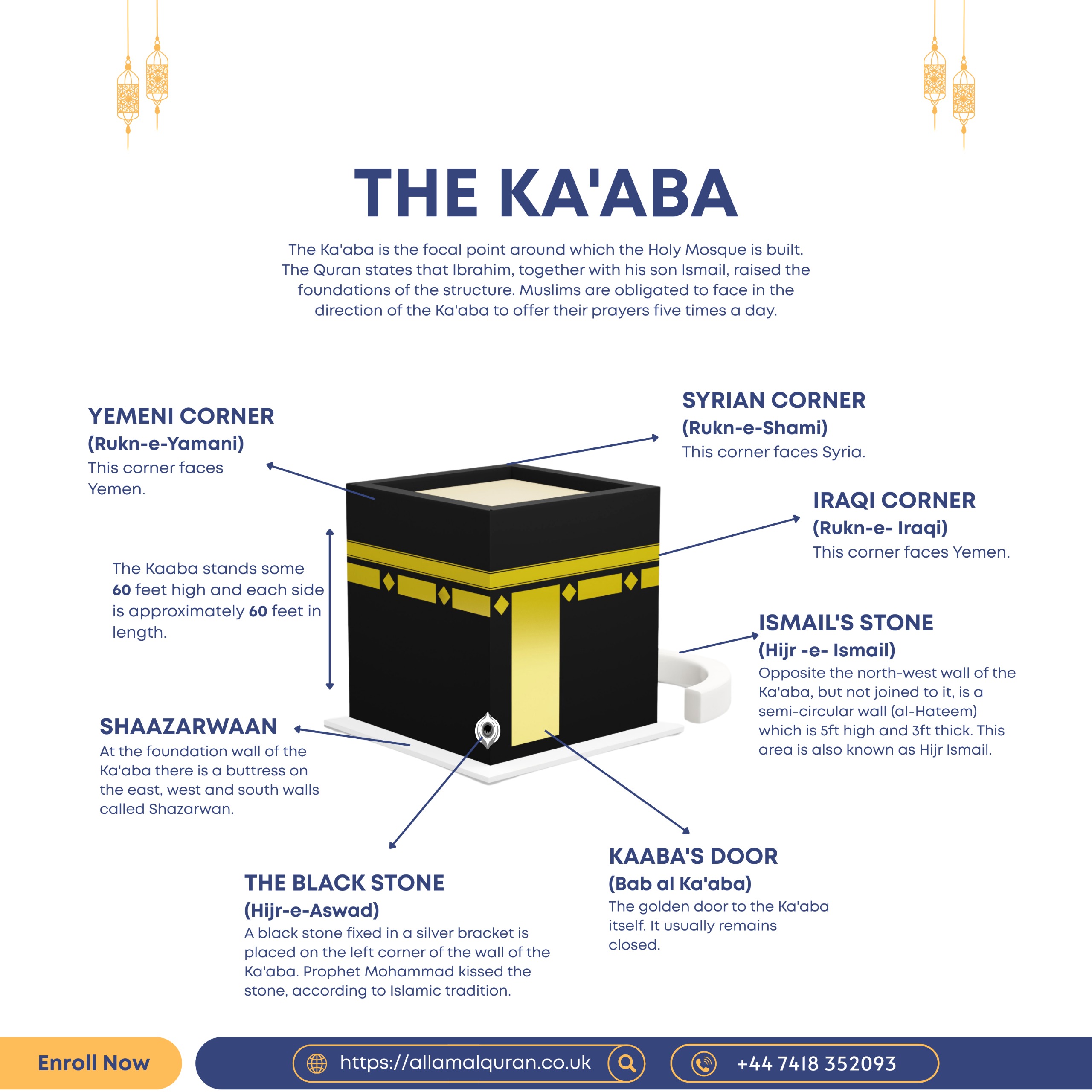
Important Parts Around THE KA'ABA
Learning the names of these features helps children and new students understand Hajj, Umrah, and Islamic history more clearly.
- Al-Hajar al-Aswad, also called the Black Stone.
- Hijr Ismail, the semi-circular area beside the structure.
- Maqam Ibrahim, connected to Prophet Ibrahim عليه السلام.
- The Kiswah, the covering placed over the sacred House.
- The corners, including the Yemeni Corner and the corner of the Black Stone.
The sacred House is a sign of unity: millions of Muslims turn to one direction while worshipping one Allah.
Teacher and Parent Q&A About THE KA'ABA
Use these simple answers when teaching children about Makkah, prayer, and pilgrimage.
Do Muslims worship it?
No. Muslims worship Allah alone. The sacred House is the direction of prayer, not an object of worship.
Why do Muslims face one direction?
Facing the Qiblah shows unity, discipline, obedience, and shared devotion.
What should children remember?
They should remember tawheed first: Allah alone is worshipped, loved, obeyed, and relied upon.
Authentic References About THE KA'ABA
Read the Quranic mention of the first House appointed for mankind at Quran.com 3:96. You can also read Quranic guidance about turning toward Masjid al-Haram at Quran.com 2:144.
Final Reflection on THE KA'ABA
THE KA'ABA reminds Muslims that worship belongs to Allah alone. Whether a believer is near it in Makkah or far away in another land, the Qiblah gathers hearts upon tawheed, humility, and obedience.