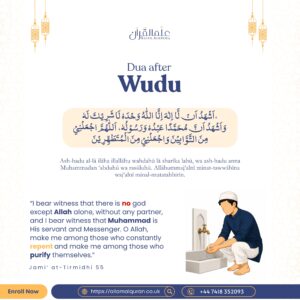

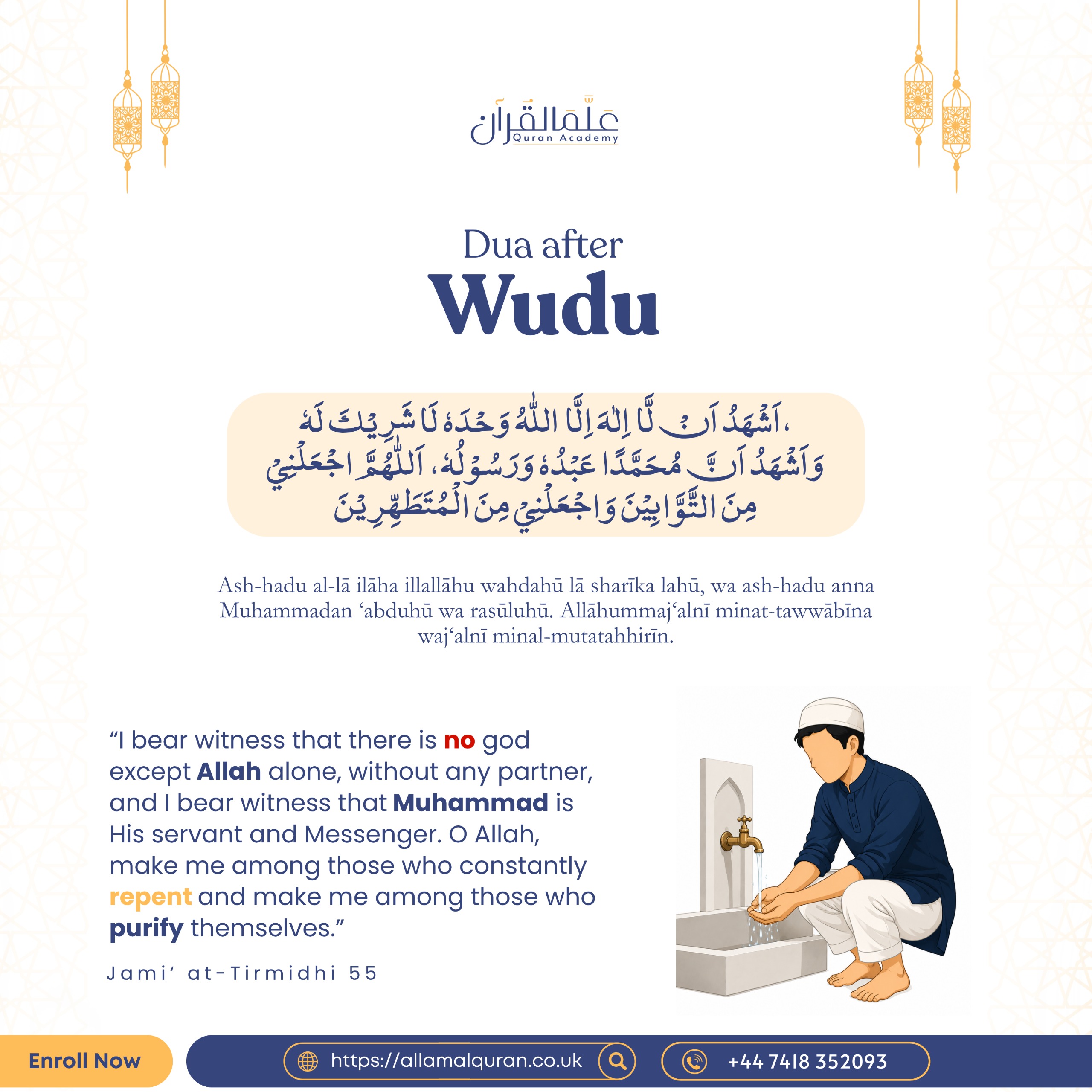
A complete supplication with Arabic, transliteration, and profound meaning – from Jami’ at-Tirmidhi 55
The Dua after Wudu is a beautiful sunnah that encapsulates the core of Islamic monotheism and the longing for spiritual purification. Recited immediately after completing ablution, it is a moment where the believer acknowledges Allah’s absolute oneness, affirms the prophethood of Muhammad ﷺ, and humbly asks to be counted among the penitent and the purified.
This supplication carries profound weight: the first part is a testimony (shahada) that reaffirms faith, while the second part is a heartfelt plea for divine acceptance. The term “at-tawwābīna” (those who repent) refers to those who constantly return to Allah, while “al-mutatahhirīn” (those who purify) signifies both physical and spiritual cleanliness. Water in Wudu washes away minor sins, and this Dua elevates the act to a station of spiritual renewal.
Imam At-Tirmidhi recorded this Dua in his renowned collection, grading it as authentic. Scholars emphasize that reciting it after Wudu opens the doors of mercy and is a means of attaining Allah’s forgiveness. The act of purification is not merely ritual; it is a preparation for standing before Allah in prayer, and this Dua bridges the physical and spiritual dimensions of worship.
In the Dua, the believer asks to be made among at-tawwābīna – those who turn back to Allah repeatedly. This reflects the human condition: we are prone to error, but Allah loves those who seek His forgiveness. Wudu itself is a physical reminder of spiritual cleansing, and the Dua transforms the act into a plea for moral and spiritual rehabilitation.
Moreover, being among al-mutatahhirīn refers to those who are outwardly and inwardly pure. This includes not only physical cleanliness but also purity of heart, intention, and actions. The Prophet ﷺ said: “When a Muslim performs Wudu, his sins exit from his body until they depart from under his nails.” This Dua asks Allah to complete that purification and to accept the servant’s striving.
Teacher (Ustadh Ahmed): “Many parents ask how to help children internalize the meaning of this Dua. The key is to break it down: first the shahada, then the dua for repentance and purification. Repetition with reflection is more valuable than mere memorization.”
Parent (Sister Fatima): “My son often rushes through Wudu. How can I encourage him to recite this Dua with presence of heart?”
Teacher: “Lead by example. Recite it aloud after your own Wudu, and explain that each word is a conversation with Allah. You may also create a small chart – when he recites it with focus, reward him. Over time, the Dua becomes a natural and cherished part of his routine.”
Parent: “What about the phrase ‘without any partner’? How do I explain that to a young child?”
Teacher: “Use simple analogies: Allah is the only Creator, the only One worthy of worship. Just as a king has no equal in his kingdom, Allah has no partner in His divinity. This builds the foundation of tawheed from an early age.”
Pro Tip: Make this Dua a consistent part of your Wudu routine. The Prophet ﷺ said: “Whoever performs Wudu and then says this Dua, the eight gates of Paradise will be opened for him.” (related by Muslim) – a immense incentive for every believer.
— written with clarity and devotion, based on authentic sources