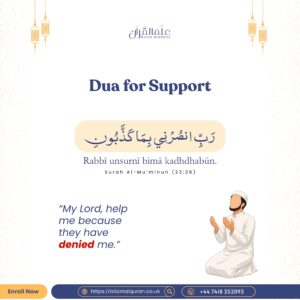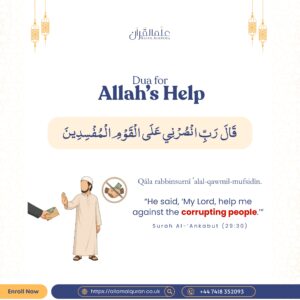

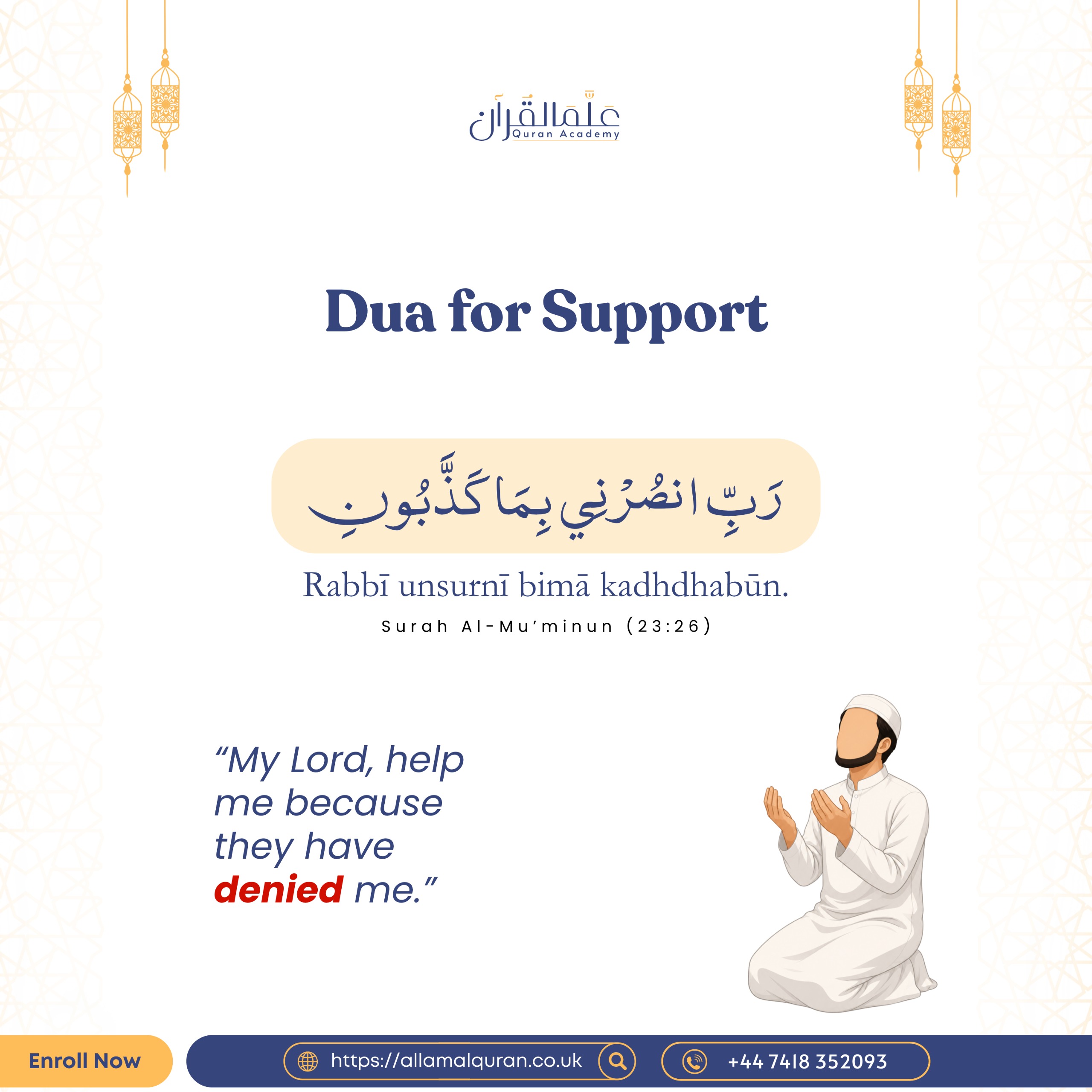
Dua for Support – Rabbi unsurni bimā kadhdhabūn – is a profound supplication uttered by Prophet Nuh (peace be upon him) when his people rejected his message. This dua, preserved in the Quran, carries timeless lessons about reliance on Allah, patience in the face of opposition, and the certainty that divine help is near. In this article, we explore its linguistic depth, spiritual significance, and practical applications, especially for parents and educators guiding young hearts.
The Arabic root ن-ص-ر (n-s-r) signifies aid, victory, and support. When Nuh calls upon his Lord with “unsurni”, he is not merely asking for rescue; he is seeking divine reinforcement, moral victory, and the strength to persevere. The word “kadhdhabūn” – derived from ك-ذ-ب (k-dh-b) – denotes repeated, emphatic denial. It is not a single act of disbelief but a persistent pattern of rejection. Thus, the dua encapsulates a desperate yet hopeful cry: “My Lord, grant me Your victory because my people have consistently denied me.”
This supplication is not exclusive to prophets. Every believer, at some point, faces rejection – whether in calling to truth, in personal relationships, or in standing up for justice. The dua teaches us that our ultimate support comes from Allah, not from human approval. It transforms our helplessness into a direct connection with the All-Hearing, All-Responsive.
Contextually, Surah Al-Mu’minun unveils the characteristics of successful believers, then contrasts them with those who deny the signs. In verse 26, Nuh’s plea is placed right after he describes the obstinacy of his people. Allah responds by instructing him to build the ark under divine supervision – a tangible answer to his prayer. This shows that support often comes in unexpected forms, aligning with Allah’s wisdom, not our expectations.
In a world saturated with criticism, social pressure, and moral relativism, many Muslims feel isolated when they uphold their values. This dua becomes an anchor. It reminds us that Allah’s help is not contingent on popular acceptance. When a teacher advocates for Islamic principles in a secular environment, or a parent faces ridicule for raising children with strong faith, this supplication reorients their hearts.
Moreover, the dua cultivates tawakkul (reliance on Allah) while encouraging proactive effort. Nuh did not stop building the ark after his prayer; he continued his mission. Similarly, we are called to seek divine help while taking practical steps. The dua is not a passive resignation but an active partnership with the Divine.
Scholars highlight that the phrase “bimā kadhdhabūn” (because they have denied me) points to the cause of the request. Nuh does not complain about his personal suffering; he frames his need in terms of the rejection of the divine message. This teaches us to align our personal struggles with the larger purpose of establishing truth. Our trials become meaningful when they are linked to our mission as believers.
The beauty of Rabbi unsurni lies in its brevity and depth. It is a concise plea that acknowledges human vulnerability while affirming divine sovereignty. It does not question Allah’s wisdom nor demand a specific outcome. Instead, it submits the entire situation to the Lord, trusting that He will respond in the best way.
Imam Al-Qurtubi mentions that this dua contains ikhlas (sincerity) and tawhid (oneness). The supplicant declares that only Allah can grant true support, and that the rejection of people does not diminish the truth. This is a powerful lesson for our times, where validation is often sought from social media and public opinion. The dua redirects our gaze to the One whose approval matters most.
Additionally, the dua teaches us to frame our requests in a manner that acknowledges Allah’s prior favours. Nuh says “because they have denied me” – implying that he has already fulfilled his duty of conveying the message. This is a subtle reminder that our supplications should be accompanied by sincere effort. We cannot expect divine support without first taking the means that are within our capacity.
﴾ رَبِّ انصُرني بِما كَذَّبونِ ﴿ — A dua that transformed despair into an ark of salvation. Let it be your anchor when the waves of denial rise against you. Recite it with conviction, teach it with love, and live it with action.
— from the timeless wisdom of Surah Al-Mu’minun.
In conclusion, the Dua for Support is far more than a historical invocation. It is a living, breathing connection between the believer and the Divine. It reframes rejection as a reason to draw closer to Allah, not to despair. For parents and teachers, it is an invaluable tool to nurture faith, patience, and reliance in the next generation. By embedding this dua in our daily lives, we transform our struggles into stepping stones towards divine mercy.
May Allah grant us the sincerity to recite this dua with understanding, and may He make us among those who are supported, guided, and victorious through His grace. Ameen.