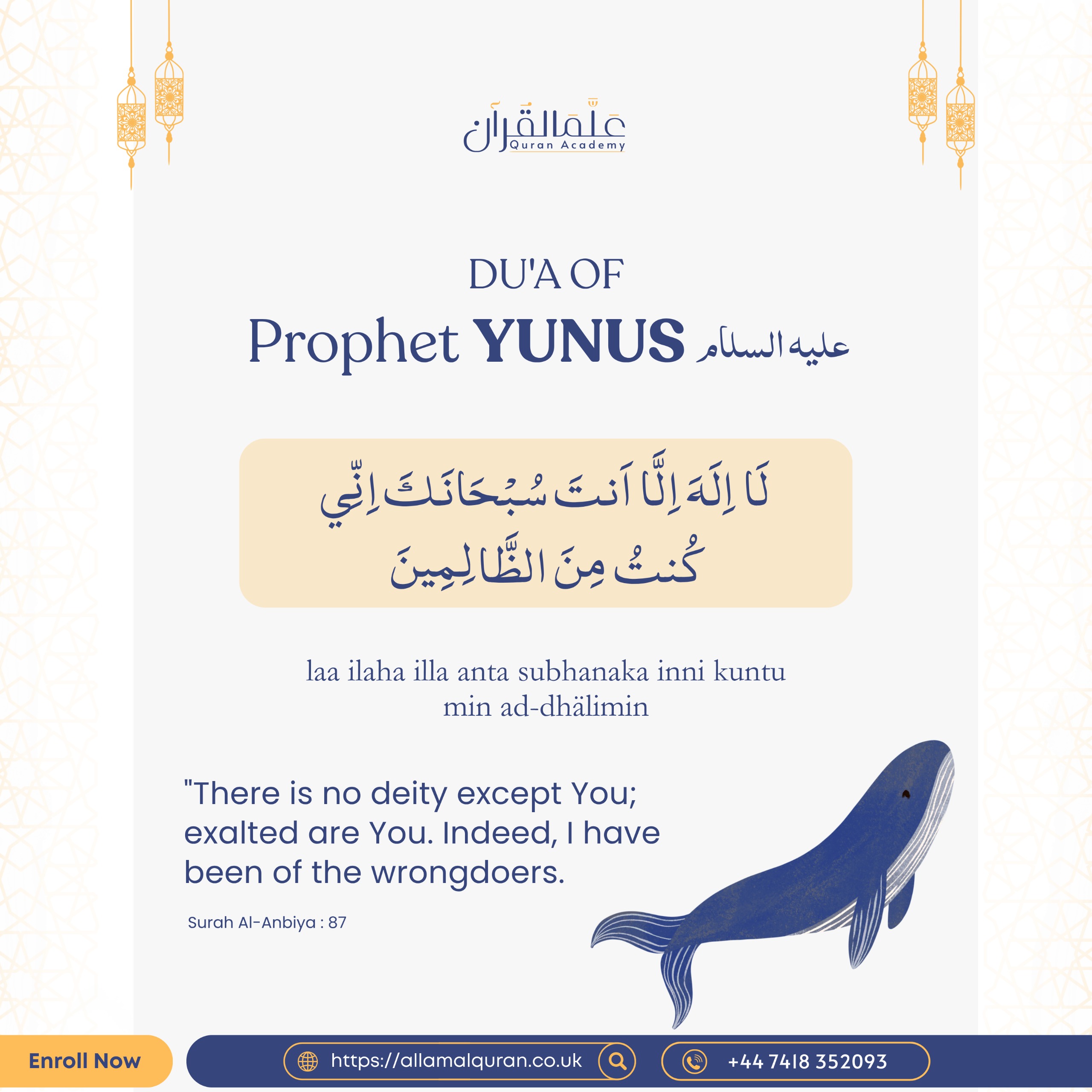
Laa ilaaha illaa Anta, Subhaanaka, inni kuntu minadh-dhaalimeen
Meaning: “There is no deity except You; exalted are You. Indeed, I have been of the wrongdoers.” Surah Al-Anbiya (21:87)
The Story Behind the Powerful Dua
Prophet Yunus (Jonah), peace be upon him, was sent to guide the people of Nineveh. When they rejected his message, he left in anger without Allah’s permission, boarding a ship that later faced a raging storm. To lighten the overloaded vessel, the crew cast lots — and the name of Yunus appeared. He was thrown into the sea, where a great whale swallowed him by Divine command. Inside the belly of the whale, submerged in utter darkness — the darkness of the deep ocean, the whale’s stomach, and the dark night — Prophet Yunus acknowledged his shortcoming. He cried out with the most profound remembrance: “Laa ilaaha illaa Anta, Subhaanaka, inni kuntu minadh-dhaalimeen”. This sincere tawbah (repentance) and declaration of Allah’s oneness, coupled with humility, became the reason for his miraculous deliverance.
Allah the Exalted says in the Qur’an: “And [mention] the man of the fish (Dhun-Nun, Prophet Yunus), when he went off in anger and thought that We would not decree anything upon him. And he called out within the darkness, ‘There is no deity except You; exalted are You. Indeed, I have been of the wrongdoers.’ So We responded to him and saved him from the distress. And thus do We save the believers.” (Surah Al-Anbiya 21:87-88). This verse reassures every believer that no matter how deep the hardship — whether emotional, spiritual, or physical — turning back to Allah with this dua unlocks relief and mercy.
Spiritual Significance & Lasting Lessons
The Dua of Prophet Yunus is not merely a historical prayer; it is a timeless formula for repentance, stress relief, and divine proximity. Scholars have highlighted that this supplication contains three fundamental pillars of Islamic spirituality: Tawheed (laa ilaaha illa Anta — affirming Allah’s exclusive right to worship), Tanzeeh (Subhaanaka — glorifying Allah above all imperfection), and Confession of Fault (inni kuntu minadh-dhaalimeen — admitting one’s own wrongdoing). Reciting it with a penitent heart, especially during times of anxiety, illness, depression, or difficulty, aligns the soul with the state of a noble prophet and invokes Allah’s special mercy.
Removal of Distress
Allah guaranteed salvation for Yunus and makes a way out for any believer who sincerely recites this dua in hardship.
Acceptance of Repentance
It's the most complete form of turning back to Allah, erasing sins and restoring inner peace.
Strengthened Tawheed
Deepens the believer's recognition that no one can remove harm except Allah alone.
Prophetic Guidance on this Dua
The Messenger of Allah (peace be upon him) said: “The supplication of Dhun-Nun (Prophet Yunus) when he called upon Allah from inside the belly of the whale: ‘Laa ilaaha illaa Anta, Subhaanaka, inni kuntu minadh-dhaalimeen.’ No Muslim ever prays to his Lord with these words for anything, except that his supplication is answered.” (Jami` at-Tirmidhi, 3505). This powerful hadith encourages every believer to memorize, internalize, and recite this dua frequently, especially in moments of crisis, before exams, during illness, or when feeling trapped by life’s circumstances.
? Teacher & Parent Dialogue
TEACHER Why is this specific dua considered so effective for children and families?
PARENT The teacher of Islamic studies explains: It teaches children that even a great prophet made a mistake but turned to Allah with humility. For parents, reciting it together instills reliance on Allah, emotional resilience and shows that admitting fault is a strength, not weakness. The simplicity of the words makes it easy for young ones, while the depth reforms adults.
TEACHER Can we incorporate this dua into daily morning/evening routine for students?
PARENT Absolutely. Many parents share that before exams or when a child feels anxious, reciting “Laa ilaaha illaa Anta Subhaanaka…” three times brings calm. The teacher recommends making it a family habit — after salah or before bedtime — and explain the story behind it. This transforms rote memorisation into heartfelt connection, and children learn to call upon Allah in every distress.
TEACHER Is there a specific number of times this dua should be recited?
PARENT According to scholars and the practice of the pious predecessors, there is no fixed number. However, many repeat it 40, 70, or 100 times during intense trouble. The sunnah is to recite it as much as the heart feels compelled. The Prophet (peace be upon him) highlighted its virtue without limiting count — sincerity outweighs quantity. For parents teaching children, starting with 3, 7, or 11 times with understanding builds a powerful spiritual habit.
TEACHER What if someone recites this dua but does not see immediate relief?
PARENT The wise teacher reminds: Relief comes in different forms — either Allah removes the hardship, grants patience with immense reward, or replaces it with something better in this world or the Hereafter. Prophet Yunus was in the whale’s belly for some time before deliverance. The dua itself transformed his state from despair to hope. Continue reciting with certainty that Allah hears every call.
How to Apply the Dua of Yunus in Modern Life
In our fast-paced world, anxiety, depression, and overwhelming challenges are rampant. Reciting the Dua of Yunus عليه السلام acts as an anchor. When facing financial strain, health crises, family conflicts, or even spiritual dryness, retreat to a quiet corner, bring the meaning to heart, and whisper: “Laa ilaaha illaa Anta, Subhaanaka, inni kuntu minadh-dhaalimeen.” Combine it with introspection: identify where you may have transgressed against yourself (dhalim) and renew your intention. Also, this supplication is a shield against panic attacks and hopelessness — it realigns the mind to Allah’s absolute power. Furthermore, parents and teachers can hold family circles narrating the whale incident; children connect deeply with the drama of the ocean and the miracle of survival, imprinting the words in their hearts.
The scholars have also deduced from this verse that “darkness” mentioned is threefold: the darkness of the night, the darkness of the deep sea, and the darkness inside the whale’s belly. Yet the light of Tawheed (Laa ilaaha illa Allah) broke it all. For us, the darkness of sins, depression, and life trials can be illuminated by this same declaration. Every recitation becomes a thread of light. In a modern context, therapists and Islamic counselors often integrate this dhikr as a mindfulness technique to reduce stress — because it aligns the heart with surrender to the Creator, eliminating false hopes from creation.
Virtues and Etiquette of Recitation
It is recommended to recite this dua when in a state of minor or major impurity (after making mental remembrance, though ablution is virtuous). However, there is no restriction; one can say it anytime, anywhere — driving, working, or before sleeping. For maximum impact, cry softly, raise your hands, and acknowledge your shortcomings. Reflect on the greatness of Allah (Subhanaka — free from all defects) and your own errors. The Prophet Yunus was forgiven and honored; through this dua, we also attain Allah’s closeness and relief from worldly and spiritual afflictions. The scholars mention that reciting it regularly fortifies Iman and blocks the whispers of Shaytan.
Key takeaway: Make this dua a daily fortress. Write it, teach it, and lean on it when waves of life overwhelm you — just as the whale became a sanctuary for Yunus, this dua becomes a sanctuary for the believer.
Reference: Surah Al-Anbiya (21:87-88) | Jami` at-Tirmidhi 3505 | Authentic dhikr for all times.
“And We saved him from the distress. And thus do We save the believers.”