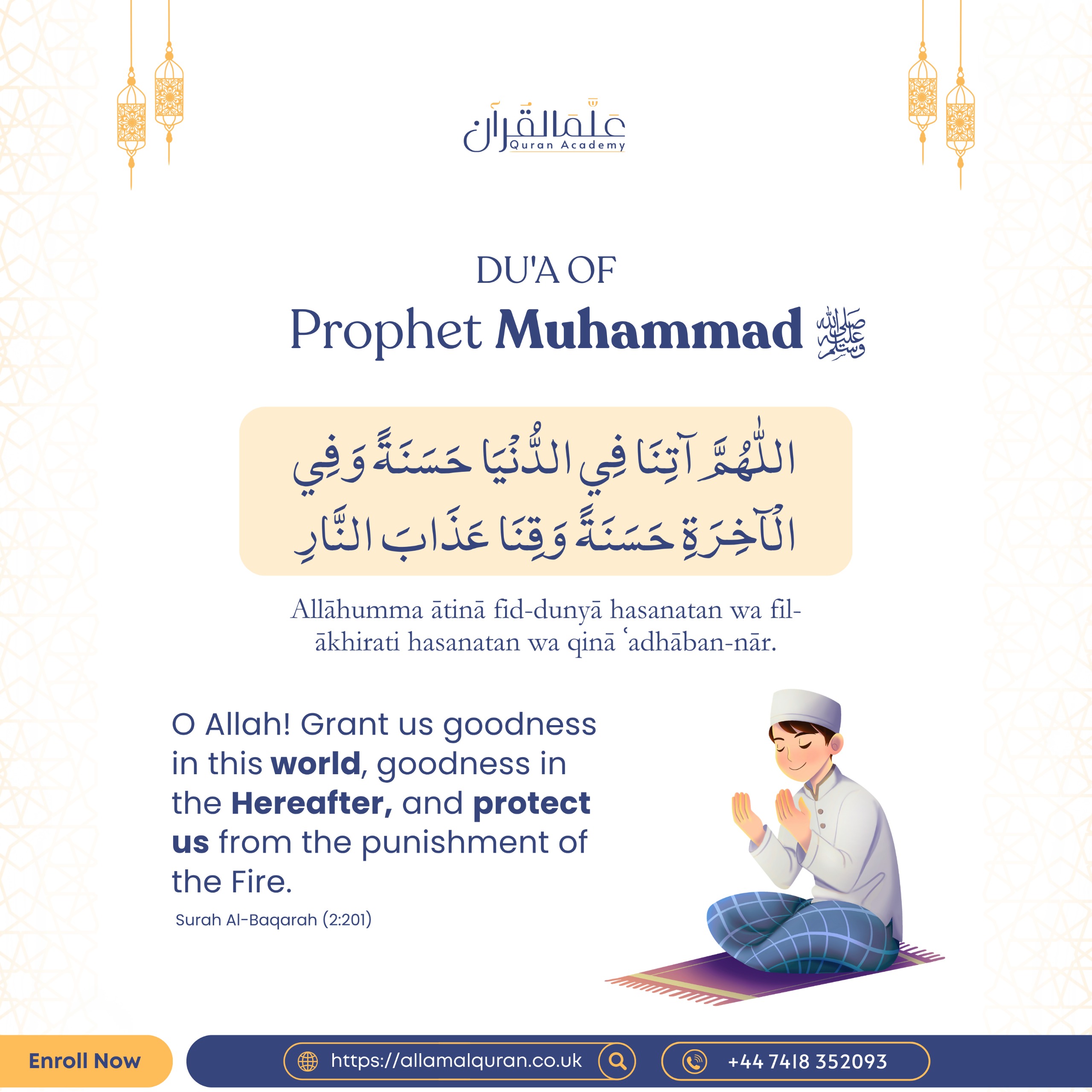
Allāhumma ātina fīd-dunya hasanatan wa fil-ākhirati hasanatan wa qina ādhāban-nār.
“O Allah! Grant us goodness in this world, goodness in the Hereafter, and protect us from the punishment of the Fire.”
Surah Al-Baqarah (2:201) • Authentic Du'a
A supplication that encompasses the entire spectrum of a believer’s aspiration — from the earthly to the eternal.
This profound du'a, taught by the Prophet Muhammad (peace be upon him), is among the most comprehensive prayers in Islam. It appears in Surah Al-Baqarah, verse 201, and it reflects the balanced worldview of a Muslim: seeking excellence (hasanah) in both dimensions of existence — the tangible life we live today and the everlasting life to come. The Prophet (PBUH) would recite it frequently, and it encapsulates the very essence of tawhid and dependence on Allah.
Why “hasanah” (goodness) is mentioned twice?
The repetition emphasizes that true success is not limited to material prosperity or spiritual detachment; rather, it is a harmonious blend. Hasanah in this world includes health, provision, righteous family, beneficial knowledge, and peaceful living. Hasanah in the Hereafter includes forgiveness, high ranks in Paradise, and the vision of Allah’s Face. The du'a then culminates with protection from the Fire — the ultimate disaster.
The Depth of the Du'a
Imam al-Qurtubi and other scholars noted that this verse is a concise yet complete prayer. It asks for every type of good, whether it is known or unknown to us, and it seeks safety from every type of evil. The Prophet (PBUH) used to say this du'a frequently, and it is reported that he taught it to his Companions as a comprehensive request. It is a recognition that we are in constant need of Allah’s grace, and that no matter how much we plan, the ultimate outcome is in His Hands.
In modern times, this du'a provides a powerful antidote to the materialism that often consumes our minds. It reminds us that while we work for our livelihood, we must also invest in our eternal abode. It cultivates a mindset of gratitude and hope, knowing that Allah is the Giver of all good. The du'a also instills humility, because seeking protection from the Fire is a sign of acknowledging our shortcomings and our need for divine mercy.
When to Recite This Du'a
Although this du'a can be recited at any time, it holds special merit after the obligatory prayers, during the last third of the night, and when making du'a for oneself or others. Many scholars recommend reciting it in the Qunoot (supplication during witr prayer) and during tawaf around the Kaaba. It is also a beautiful du'a to teach children, as it encompasses their wellbeing in both worlds.
Questions & Answers – Teachers & Parents
How can we explain the meaning of “goodness in this world” to young children?
Teacher: We can tell them that it means having a loving family, good friends, healthy food, and a kind heart. It also means being successful in school and helping others. For older children, we can include having a good job and being a source of benefit for people.
What is the best way to incorporate this du'a into a child's daily routine?
Parent: We recite it after each of the five daily prayers, and also before sleeping. We have a small poster with the du'a in Arabic and English on the wall, and we take turns reading it together. Consistency and loving repetition make it stick.
Does “goodness in the Hereafter” mean only Paradise, or does it include other things?
Teacher: It primarily includes Paradise, but it also encompasses forgiveness, safety from the trials of the grave, the intercession of the Prophet (PBUH), and the pleasure of Allah. It is a comprehensive term for all that brings us closer to Allah and success in the eternal life.
How do we handle a child who asks, “Why do we need to be protected from the Fire if we are good?”
Parent: We explain that the Fire is a reality and that even the best of believers seek Allah’s protection out of humility and fear. It is not because we are bad, but because we recognize that only Allah’s mercy can save us. It also teaches us to never be arrogant about our deeds.
Can this du'a be recited for someone else, like a sick relative?
Teacher: Absolutely. The Prophet (PBUH) encouraged making du'a for others. You can say, “Allāhumma ātina …” and also include the person’s name. For example, “O Allah, grant us and him/her goodness in this world and the Hereafter.” It is a beautiful way to show care and solidarity.
Final Reflection
This du'a is a gift from the Prophet (PBUH) to his ummah. It is short yet immense in meaning, easy to memorize yet profound in impact. By reciting it regularly, we align our hearts with the ultimate purpose of life: to worship Allah and seek His pleasure. It protects us from the extremes of worldliness and neglect of the afterlife, giving us a balanced, wholesome approach to every aspect of our existence.
Takeaway: Let this du'a be a constant companion—on your tongue, in your heart, and in your actions. For it is the key to both worldly success and eternal salvation, and it was the prayer of the best of creation, Muhammad (PBUH).