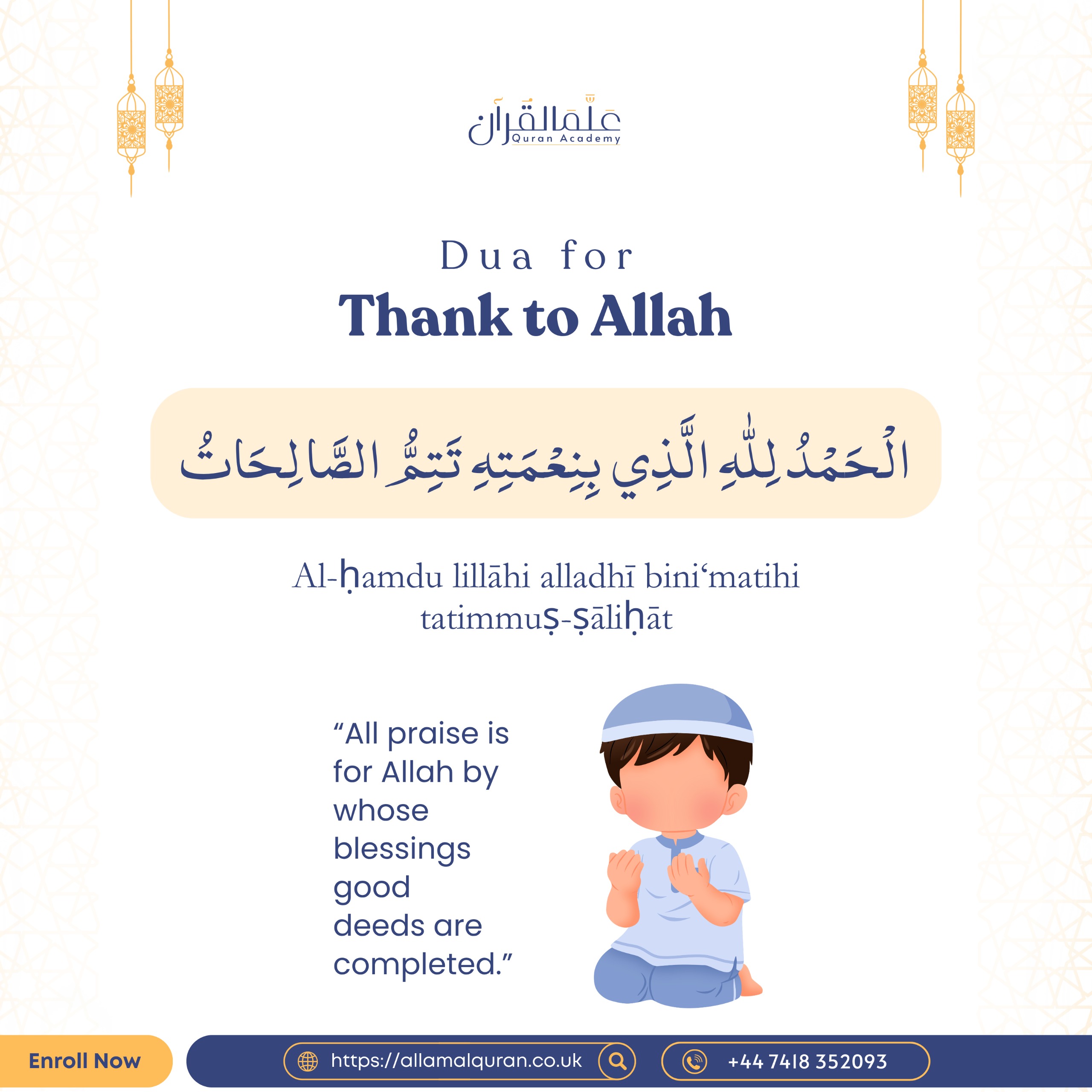
In the noble Quran and Sunnah, Shukr (gratitude) stands as a pillar of faith. Allah promises increase to those who give thanks: "If you are grateful, I will surely increase you [in favor]" (Quran 14:7). The Dua “Al-ḥamdulillāh alladhī biniʿmatihi tatimmuṣ-ṣāliḥāt” is an exquisite expression of praise, reminding believers that every righteous deed reaches completion only through the grace and mercy of Allah. This supplication is often recited after finishing a meal, completing a good act, or achieving a milestone — embedding Tawheed and humility into daily life.
This specific wording goes beyond simple "Alhamdulillah". It acknowledges two magnificent realities: first, that all praise belongs to Allah alone; second, that our righteous deeds (ṣāliḥāt) become perfected exclusively by His blessings. Scholars explain that even the ability to perform good actions — like praying, fasting, charity, or raising pious children — is a gift from Allah. Therefore, thanking Allah for enabling and completing these deeds creates a beautiful loop of gratitude and spiritual elevation. Reciting this dua regularly trains the heart to recognize Divine providence in every success, big or small, pushing away arrogance and self-admiration.
✦ The Prophet Muhammad (peace be upon him) would often say “Alhamdulillah” in every situation. The companions narrated that whenever something pleasing occurred or a good deed was accomplished, he would recite similar words of praise. This specific dua has been transmitted as a comprehensive formula of thankfulness, ensuring the believer’s gratitude is both verbal and heartfelt. ✦
Parents can teach this dua to children after finishing homework or household chores, making thankfulness a habit. Teachers in Islamic schools often encourage students to recite it after group activities or study sessions. For adults, reciting this dua upon completing any religious or worldly task — from finishing a work project to preparing a meal — elevates the mundane into an act of worship. The psychological benefit is immense: it reduces stress, shifts focus to blessings, and fosters contentment. Remember, gratitude is not only for big victories; it flourishes in small daily moments. Additionally, repeating this dua with presence of mind opens doors to barakah (blessings) in one’s time and resources.
Scholars of tazkiyah (purification) mention that when a believer says “bini’matihi tatimmuṣ-ṣāliḥāt”, they affirm that no righteous act is self-sufficient. Even the ability to intend goodness comes from Allah’s mercy. This mindset crushes ego and cultivates sincere humility. Furthermore, the phrase "al-ḥamdu lillāh" encompasses praise for His beauty, perfection, and blessings. Adding “alladhī bini’matihi...” narrows the focus to the completion of good deeds — a powerful reminder that every moment we reach a virtuous end is due to divine facilitation. Consequently, this Dua for Thanks to Allah becomes a shield against spiritual diseases like jealousy, pride, and ingratitude. It transforms ordinary achievements into profound acts of worship and reliance on Allah.
While the regular “Alhamdulillah” is universal, this specific dua is uniquely tied to the completion of righteous actions. Many Islamic scholars recommend it when concluding gatherings of dhikr, finishing the Quran, or after voluntary prayers. The deeper benefit is that it seals your deeds with remembrance of Allah, ensuring that the barakah of that action continues to ripple through your day. As the Quran says, "And the close of their call will be, 'Al-ḥamdu lillāhi rabbi l-ʿālamīn'." (Quran 10:10). By adopting this dua, a believer aligns their tongue with the language of the people of Jannah.
Teacher Fatima: Start with storytelling. Tell a child: "Imagine you built a sandcastle, but without the help of water and tools it would be nothing. Similarly, every good thing we do — helping others, studying, being kind — happens because Allah gives us strength. This Dua says 'Thank you, Allah, for helping us finish good deeds'. Use simple activities: after a child finishes drawing, let them repeat the Dua together. Visual aids and repetition build meaning."
Parent Omar: We use a gratitude jar. Every time my daughter says this Dua after completing a task, we add a note. She now understands that thanking Allah brings happiness and more blessings. It’s beautiful!
🟢 Teacher Abdullah: Consistency comes from modeling and gentle reminders. I incorporate this Dua at the end of every class activity, turning it into a collective habit. Parents can do the same before bedtime or after family meals. Use a tracker chart with stickers — positive reinforcement works wonders. Also explain the 'reward': Allah loves the thankful servant. Over time, children internalize the practice.
Parent Layla: We set a “Dua ringtone” at 7 PM daily. Our family pauses, shares one completed good deed, then recites the Dua. It’s now a joyful routine, not a chore. The key is linking it with love and consistency.
🟢 Teacher Aisha: For ages 4-7, use calligraphy coloring pages of the Dua, and simple songs (nasheed style). For ages 8-12, create a “Gratitude journal” where they write one completed deed each day and recite the Dua. Role-playing: "What would you say to Allah after finishing your homework?" For teens, discuss the deeper tafsir and how it fights depression. Also, a classroom challenge: recite the Dua after every group project, then reflect on teamwork as Allah’s blessing.
🟡 Parent Khalid: We crafted a poster with the Dua in Arabic and English, hung in the study area. Each time my son finishes his online class, we tap the poster and say it together. Visual cues are powerful.
🟢 Teacher Hassan: Communication is key. Create a monthly “gratitude challenge” with both classroom and home components. For example, send a note to parents about the Dua of the month, and ask them to practice it with their child after homework. Then, children share experiences in class. Use a WhatsApp group for families to share moments of reciting the Dua. School newsletters can feature the Dua with translation. Unity between home and school accelerates learning and love for the sunnah.
🟡 Parent Samira: Our parent-teacher association designed flashcards with this Dua and others. Teachers and parents use same flashcards — consistent language boosts memory. We also organize a quarterly “Thanks to Allah” event where kids present acts of kindness and recite this Dua together. The feeling of community is amazing.
Each recitation brings you closer to Allah’s endless mercy.