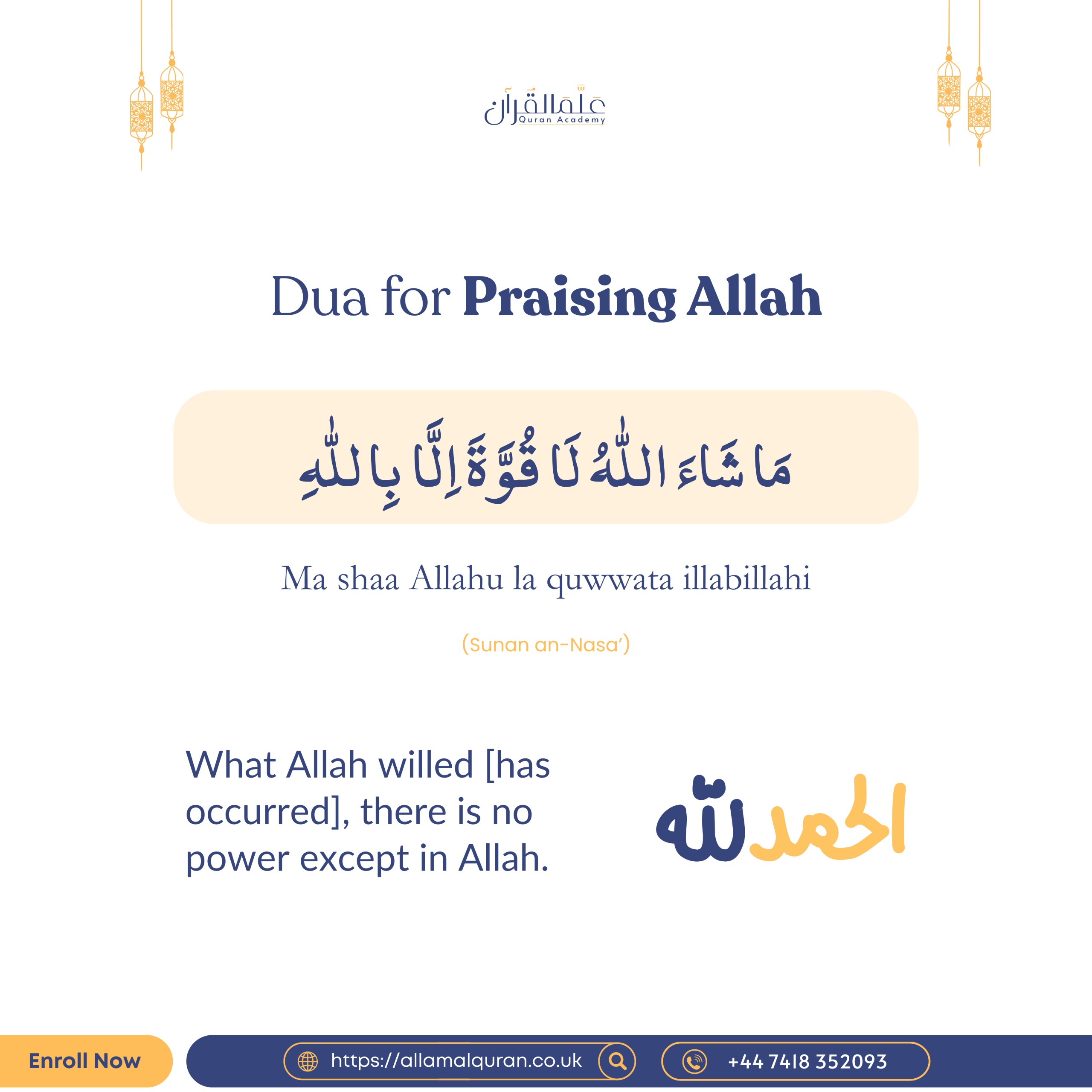
مَا شَاءَ اللَّهُ لَا قُوَّةَ إِلَّا بِاللَّهِ
Ma shaa Allahu la quwwata illabillahi
“What Allah willed has occurred, there is no power except in Allah.”
Sunan an-Nasa’ | Authentic
This magnificent Dua, recorded in Sunan an-Nasa’, is far more than a string of words.
It is a profound declaration of tawheed (oneness of Allah), a shield against pride, and a key to unlocking divine blessings.
When a believer utters “Ma shaa Allahu la quwwata illabillahi”, they affirm that every event unfolds by Allah’s will and that all power—physical, intellectual, or spiritual—originates solely from Him.
The Deeper Meaning & Significance
The Dua consists of two powerful affirmations. First, “Ma shaa Allah” — whatever Allah wills, happens. This instils complete رضا (contentment) with divine decree.
Second, “la quwwata illa billah” — there is no power except with Allah. This strips the self of any illusion of independent strength.
It is a Dua of humility, gratitude, and reliance.
Scholars explain that reciting it upon seeing beauty, wealth, or even a calamity protects the heart from hasad (envy) and ‘ujb (self-admiration).
It realigns the believer’s perspective: everything good is from Allah, and everything that occurs is under His dominion.
Key takeaway: This Dua is a spiritual anchor. It transforms a moment of amazement into an act of worship, and a moment of hardship into a reminder of Allah’s ultimate authority. The Prophet ﷺ taught it as a means of preserving faith and fostering tawakkul (trust in Allah).
5 Profound Benefits of this Dua
- Protection from envy: It safeguards the one who recites it and the one who is admired from the evil eye.
- Strengthens tawheed: It roots out any trace of shirk in power or will, purifying one’s creed.
- Cultivates humility: Reminds the soul that all ability is loaned from Allah, preventing arrogance.
- Opens doors of barakah: When recited upon seeing blessings, it invites more blessings and contentment.
- Increases reliance on Allah: Regularly reciting it deepens the feeling that Allah alone is the disposer of all affairs.
Teacher & Parent Q&A
How can I explain this Dua to young children in a simple way?
Start by relating it to everyday moments—like when they see a beautiful flower or a strong friend. Tell them: “Allah made this, and only Allah gives strength.” Use stories of prophets like Musa (AS) who said “My strength is from Allah.” Repeat it after prayers and encourage them to say it when they feel proud.
Is there a specific time or situation to recite this Dua?
While it is especially recommended when seeing something admirable (property, children, skills), it is a general Dua of praise. Many scholars recommend reciting it daily in the morning and evening as part of your adhkar, to keep the heart connected to Allah’s sovereignty.
What if I forget to say it when I see something amazing?
No worry. You can say it later as soon as you remember. The Prophet ﷺ taught that the Dua is a form of remembrance, and Allah loves those who remember Him. The intention and the act of saying it, even later, carries reward and barakah.
How does this Dua protect from the evil eye?
Because it acknowledges that all power belongs to Allah. When you say it, you are shielding the blessing (or the person) from envy by attributing its existence to Allah alone. It deflects the harmful glance of envy and invites Allah’s protection.
Can parents use this Dua to teach gratitude?
Absolutely. When children receive a gift or achieve something, parents can say “Ma shaa Allah, la quwwata illa billah” to model gratitude. It teaches them that success comes from Allah, and that every ability is a trust. This builds a grateful and humble character.
Is this Dua only for praising Allah or can it be used as a supplication?
It is primarily a Dua of praise and acknowledgment. However, scholars mention that it can be recited as a supplication for protection and strength, because by praising Allah with His own attributes, you are drawing near to Him. It is both a praise and a plea.
Imam An-Nawawi said: “This Dua is a comprehensive expression of tawheed and tawakkul. The servant acknowledges that nothing occurs without Allah’s will, and no power exists except through Him. It is a cure for the heart’s diseases.”
Reflect & Recite Daily