Dua for Relief from Pain
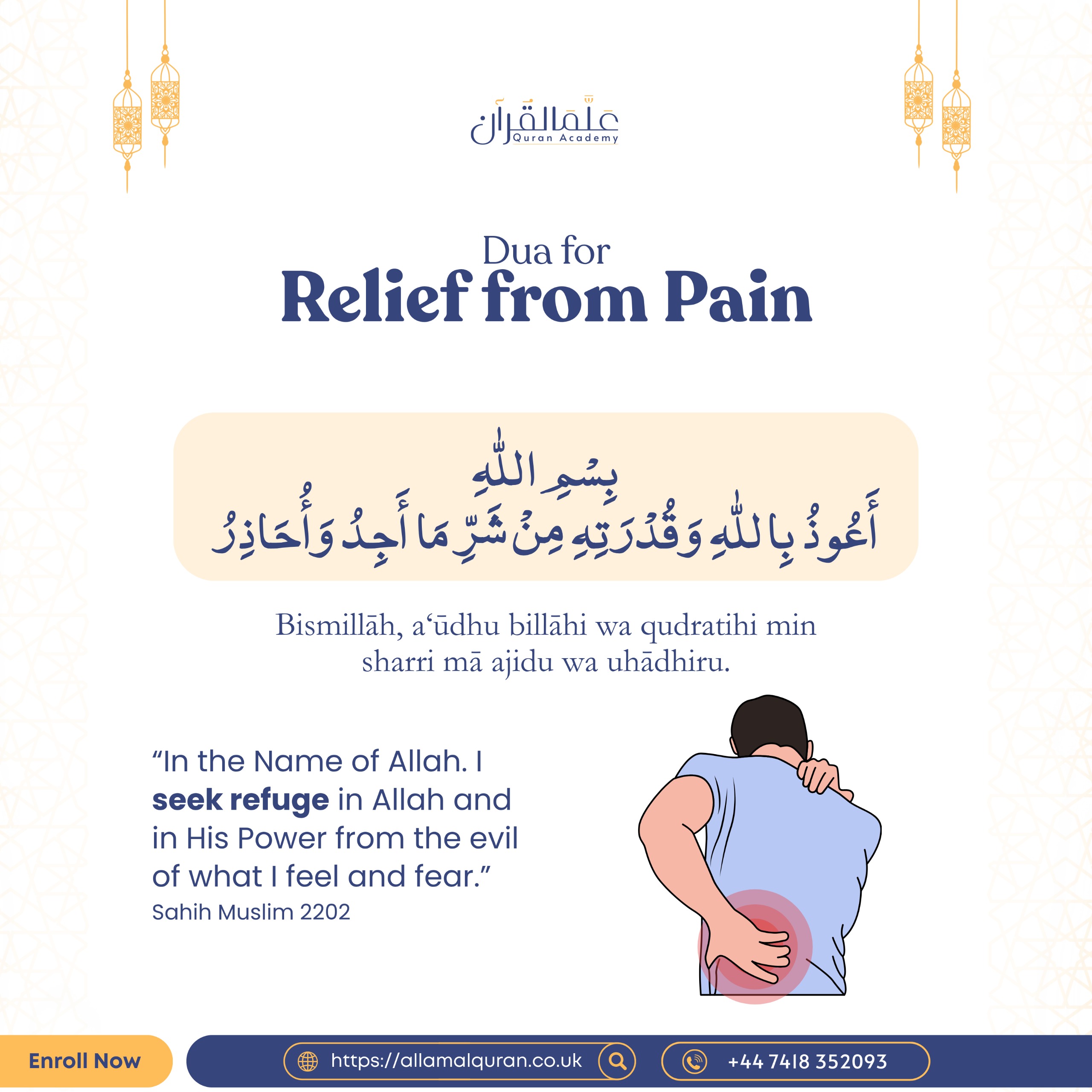
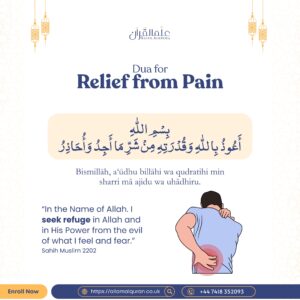
بِسْمِ اللّٰهِ
أَعُوذُ بِاللّٰهِ وَقُدْرَتِهِ مِنْ شَرِّ مَا أَجِدُ وَأُحَاذِرُ
Bismillāh, a‘ūdhu billāhi wa qudratihi min sharri mā ajidu wa uhādhiru.
Meaning: “In the Name of Allah. I seek refuge in Allah and in His Power from the evil of what I feel and fear.”
Sahih Muslim 2202
Authentic Hadith
Narrated by Muslim (2202) – A powerful supplication for physical and spiritual healing.
Understanding the Dua for Pain Relief
This profound supplication, taught by the Prophet Muhammad (peace be upon him), encapsulates tawakkul (reliance on Allah) and the acknowledgment of Allah’s absolute power over all pain and fear.
When a person is afflicted with physical agony, emotional distress, or even anticipatory anxiety, this Dua serves as a spiritual shield. By saying “Bismillāh” we begin with the name of Allah, seeking blessings.
Then, “a‘ūdhu billāhi wa qudratihi” – we seek refuge in Allah and in His power. This is unique because it couples seeking protection with the attribute of qudrah (omnipotence).
The phrase “min sharri mā ajidu” covers all current pain – whether a headache, joint pain, or internal suffering. And “wa uhādhiru” extends to what we fear might happen – future pain, complications, or distress.
The beauty of this Dua lies in its comprehensiveness: it addresses both the present and the future, both the known and the unknown.
Scholars explain that by reciting it, a believer surrenders their condition to Allah, trusting that His power surpasses every ailment. It is not a replacement for medical treatment but a complementary spiritual practice that brings tranquility to the heart.
In times of severe illness, this Dua was repeatedly recited by the Companions, and it continues to be a source of solace for millions.
Why This Dua is a Spiritual Remedy
- ✓ Protection from despair – acknowledges that pain is from Allah’s decree, and He alone can remove it.
- ✓ Combines physical and emotional healing – covers both what we feel and what we fear.
- ✓ Strengthens tawhid – by seeking refuge in Allah’s power, we affirm His absolute control.
- ✓ Easy to memorize and teach – short yet profound, ideal for all ages.
Teacher & Parent Dialogue on the Dua
Teacher (Ustadhah Fatima): “How can we effectively teach this Dua to children who are afraid of injections or medical procedures?”
Parent (Abu Zayd): “We can break it down phrase by phrase. First, we teach them ‘Bismillāh’ – starting with Allah’s name. Then we explain that Allah’s power is greater than any needle or pain. We practice it together before visits, and it remarkably calms them.”
Teacher: “What if a child is too young to understand the meaning? Is it still beneficial?”
Parent: “Absolutely. The barakah of the Arabic words carries immense benefit. We encourage them to repeat after us, and we narrate the story of the Prophet using this Dua. Over time, they internalize it.”
Teacher: “Should we recite it only during physical pain, or can it be used for anxiety as well?”
Parent: “The Dua explicitly mentions ‘what I fear’, so it covers anxiety, exam stress, or even fear of the dark. We encourage our children to recite it whenever they feel uneasy – it builds resilience and tawakkul.”
“This Dua is a gift from the Prophet – it transforms fear into faith.”
Frequently Asked Questions
What is the exact Dua for relief from pain?
The Dua is: “Bismillāh, a‘ūdhu billāhi wa qudratihi min sharri mā ajidu wa uhādhiru.” It is recorded in Sahih Muslim (2202).
Can this Dua be recited for someone else?
Yes, you can recite it on behalf of a loved one. It is recommended to place your hand on the area of pain and recite, seeking Allah’s healing for them.
Is there a specific time to recite this Dua?
It can be recited at any time – during pain, before sleep, after prayer, or when feeling anxious. Consistency is key.
Does this Dua replace medical treatment?
No, it complements medical treatment. The Prophet encouraged seeking both spiritual and physical remedies. It is a means of tawakkul alongside taking practical steps.
Make this Dua a daily habit – recite it with conviction, and witness the peace it brings to your heart and body.
“And when I am ill, it is He who cures me.” (Ash-Shu‘ara 26:80)
Recite with devotion
Last updated: 25 August 2026 | Compiled from authentic sources