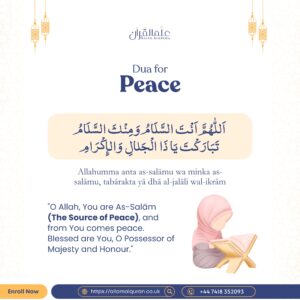

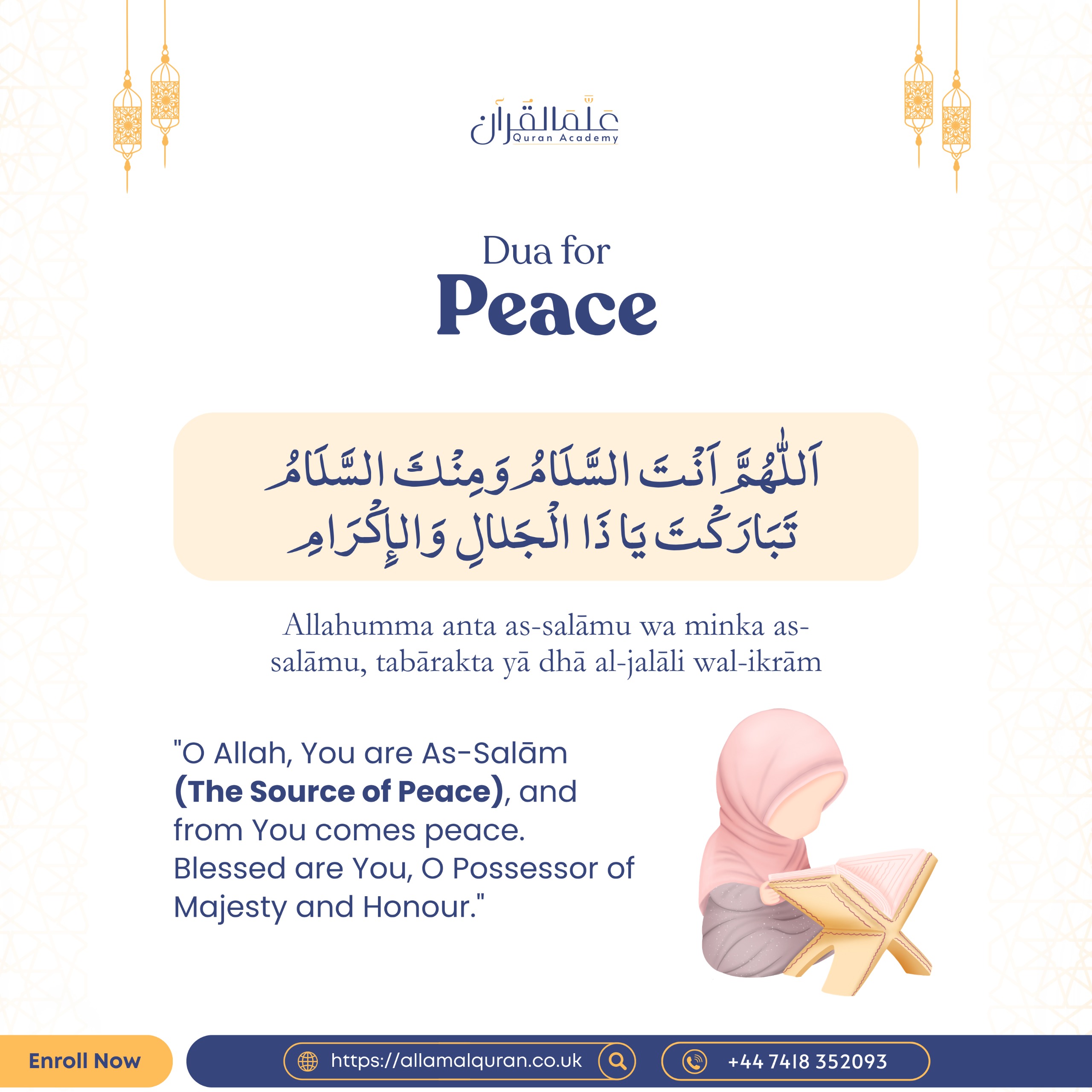
“Allahumma anta as-salāmu wa minka as-salāmu, tabārakta yā dhā al-jalāli wal-ikrām”
The Essence of Divine Peace
In the chaos of modern life, the heart yearns for a stillness that transcends circumstance. The Dua for Peace — “Allahumma anta as-salāmu wa minka as-salāmu” — is not merely a string of words; it is a spiritual anchor. This supplication, taught by the Prophet Muhammad (peace be upon him), acknowledges Allah as As-Salām, the Ultimate Source of safety, wholeness, and tranquility. When we recite it, we align our souls with the very origin of peace, recognizing that all external calmness is a reflection of His divine attribute.
The dua continues with “tabārakta yā dhā al-jalāli wal-ikrām” — “Blessed are You, O Possessor of Majesty and Honour.” This exaltation reminds us that true peace is inseparable from the awe and reverence of Allah’s greatness. It is a declaration that peace is not passive; it is active, majestic, and honourable. By internalising these words, believers cultivate a sense of security that no worldly disturbance can erode.
KEY INSIGHT The dua for peace is a complete spiritual prescription: it acknowledges the Giver of peace, requests peace, and glorifies the One who is Majestic and Generous.
Every syllable of this dua carries profound depth. “Allahumma” is a direct call to Allah, the Almighty, invoking His mercy and attention. “Anta as-salāmu” — “You are Peace” — establishes that peace is not an abstract idea but a living reality rooted in Allah’s essence. He is not merely a bestower of peace; He is Peace itself. This shifts the believer’s dependency from ephemeral sources to the Eternal.
The second clause, “wa minka as-salāmu” — “and from You comes peace” — acknowledges that every moment of serenity, every sigh of relief, and every healed heart is a gift from Him. It cultivates gratitude and humility, reminding us that we are recipients of a divine favour. The final part, “tabārakta yā dhā al-jalāli wal-ikrām”, elevates the dua into a doxology, praising Allah for His magnificence (al-Jalāl) and generosity (al-Ikrām). This combination ensures that the supplicant approaches peace with both love and awe — a balanced spiritual state.
Practical insights from educators and parents on teaching the Dua for Peace to the next generation.
Q Teacher: How can we explain “As-Salām” to young children in a relatable way?
A: Compare it to a safe harbour. Just as a harbour protects ships from storms, Allah protects our hearts. Tell them: “When you feel scared or sad, remember Allah is the One who makes everything safe and calm.”
Q Parent: My child asks, “Why does Allah have majesty and honour?” How do I respond?
A: Use the analogy of a king who is not only powerful but also generous. Allah’s majesty means He is above all imperfections, and His honour means He gives without limit. When we praise Him with these names, we feel both awe and love.
Q Teacher: What practical tips can help a family make this dua a daily habit?
A: Recite it together after every Fajr prayer, and before bedtime. Create a “peace jar” where each family member drops a note of something that gave them peace that day, then recite the dua in gratitude. Consistency builds connection.
When we internalise the Dua for Peace, it does not remain a private whisper. It radiates outward. A person who is anchored in as-Salām becomes a source of peace for others — in the home, the workplace, and the community. The Prophet (peace be upon him) said, “The Muslim is the one from whose tongue and hand others are safe.” This dua equips us to embody that safety. It softens the heart, curbs anger, and fosters forgiveness.
Moreover, this supplication is a profound meditation on the divine names. Al-Jalāl (Majesty) and Al-Ikrām (Generosity) remind us that Allah’s peace is not weak or passive; it is powerful, honourable, and overflowing. By combining peace with majesty, the dua dismantles the false notion that peace is only for the meek. True peace, in the Islamic worldview, is bold, dignified, and transformative.
In a world saturated with noise, the Dua for Peace is a sanctuary. It is a direct line to the Creator, a reminder that peace is not found in circumstances but in the conscious connection with As-Salām. May we all recite it with presence, live by its meaning, and become ambassadors of the peace that descends from the Majestic and Generous Lord.