
The promise of response — a certainty for every distressed soul
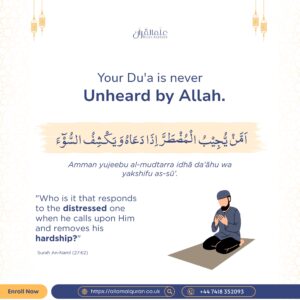
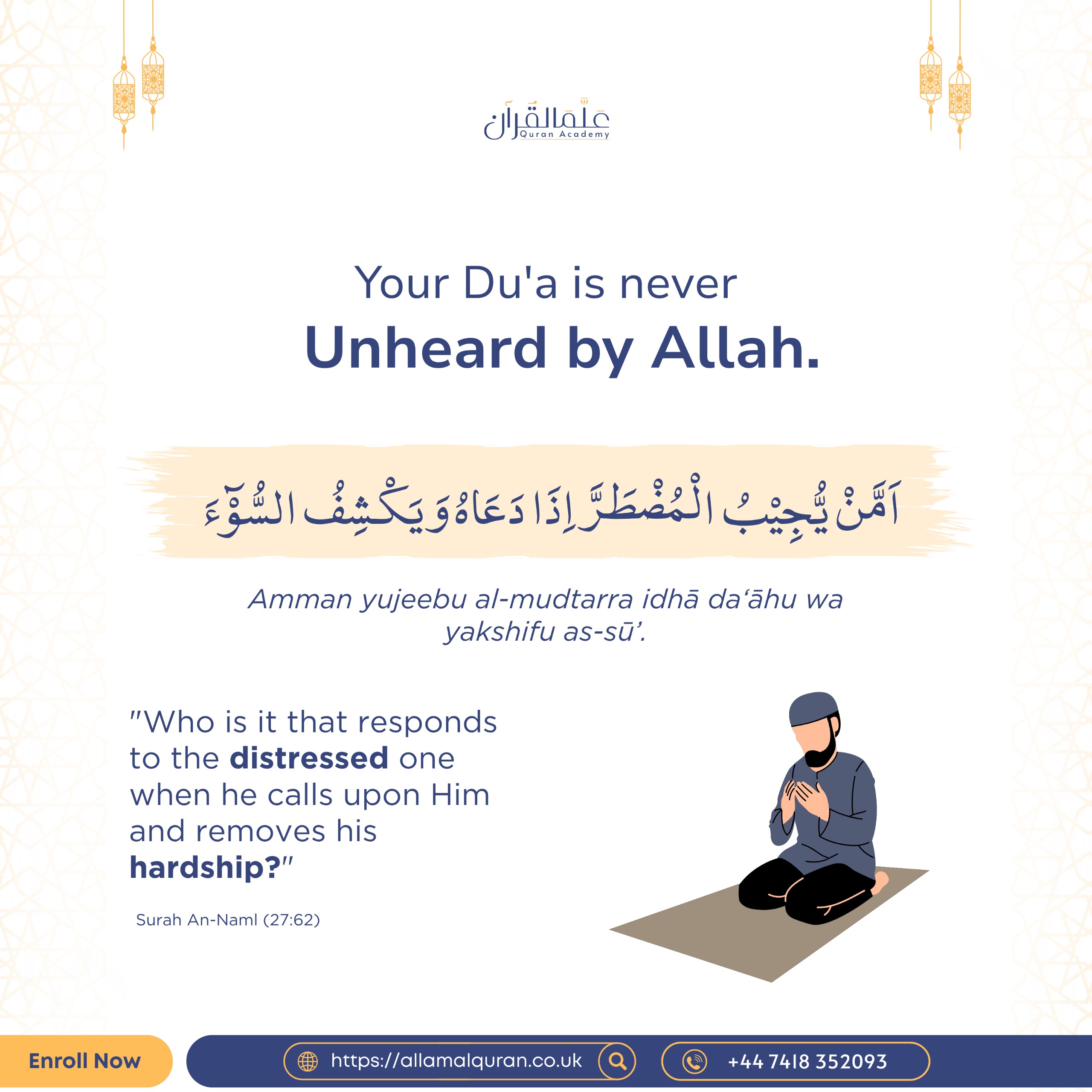
“Who is it that responds to the distressed one when he calls upon Him and removes his hardship?”
No call is wasted. Not a single whisper, not a tear that falls in the silence of the night. Allah, the All‑Hearing, has guaranteed His response — not always in the way we expect, but always in the way that is best. The verse from Surah An-Naml is a profound anchor: it does not say “perhaps” or “maybe”. It declares with absolute certainty that the One who answers the distressed is Allah Himself.
“Amman yujeebu al-mudtarra ...” — This is not a conditional promise. It is a statement of fact. When the heart is broken, when the world seems narrow, when every door appears closed — that is the very moment when Allah’s response is closest. The mudtar (distressed one) has a special station: his du’a pierces the heavens.
The Arabic word “mudtar” goes beyond ordinary worry. It describes a state of utter helplessness, where all human means have been exhausted. It is the cry of the one who has nowhere else to turn. And Allah says: “I respond to him.” Not “I might” or “I will consider” — but I respond. This is the essence of tawhid: that we direct our ultimate need to the only One who can truly remove harm.
Imam Ibn Kathir (may Allah have mercy on him) mentions that this verse is a direct proof of Allah’s mercy and His nearness to His servants. He is not distant or unaware. He hears the faintest sigh and knows the unspoken pain. The response may come as immediate relief, or as patience, or as a greater good that we cannot yet perceive. But the response is guaranteed.
The Prophet (peace be upon him) said: “Du’a is the essence of worship.” And in another hadith: “There is nothing more honourable to Allah than du’a.” When you raise your hands, you are engaging in the most noble act. The rejection is not in the du’a itself; it is in our own impatience or in our perception of what is “good.” Allah may delay, replace, or elevate. Every du’a is either granted in this world, stored for the Hereafter, or used to avert a calamity. Nothing is lost.
One of the conditions of acceptance is yaqeen (certainty) — that you call upon Allah with full conviction that He will answer. The verse from An-Naml does not leave room for doubt. It presents a rhetorical question that affirms the absolute truth: “Who is it that responds ... ?” The answer is self-evident: only Allah. So when you call, call with the certainty that the Lord of the worlds is listening and that He is the most generous.
Our beloved Prophet (peace be upon him) taught us: “Call upon Allah while being certain of the response, and know that Allah does not answer a du’a from a heedless, inattentive heart.” This means we should be present, mindful, and fully trusting.
For parents and educators, this verse is a powerful tool to instill in children the concept of divine closeness. When a child is distressed — over a test, a friendship, or a fear — we can remind them: “Allah hears you; He is closer to you than your own jugular vein.” We teach them that du’a is not a last resort, but the first and most powerful resort. And we model this by making du’a a natural part of our daily life, not only in times of crisis but in moments of gratitude and ease as well.
The verse ends with “wa yakshifu as-sū’” — and He removes the hardship. This removal can be instantaneous, gradual, or even in the form of a changed heart that no longer feels the weight. The ultimate hardship is the punishment of the Hereafter, and the ultimate relief is forgiveness and entry into Jannah. So every du’a for relief is connected to the greater relief of the soul.
When we teach this verse, we emphasize that Allah’s mercy is vast. He does not merely “hear” — He responds and removes. This is the beauty of tawhid: the Creator is not indifferent. He is Al-Mujib (The Responsive), Al-Kashif (The Remover of Distress).
Hold onto this certainty:
“Your du’a is heard”Click to affirm that Allah responds to the distressed
In summary: The verse from Surah An-Naml is not just a piece of revelation — it is a living promise. Every tear, every whisper, every silent cry reaches the Throne. No du’a is ever rejected, for Allah is the All‑Hearing, the All‑Knowing. So call upon Him with a heart full of hope, and know that the response is already written in the best of ways.