
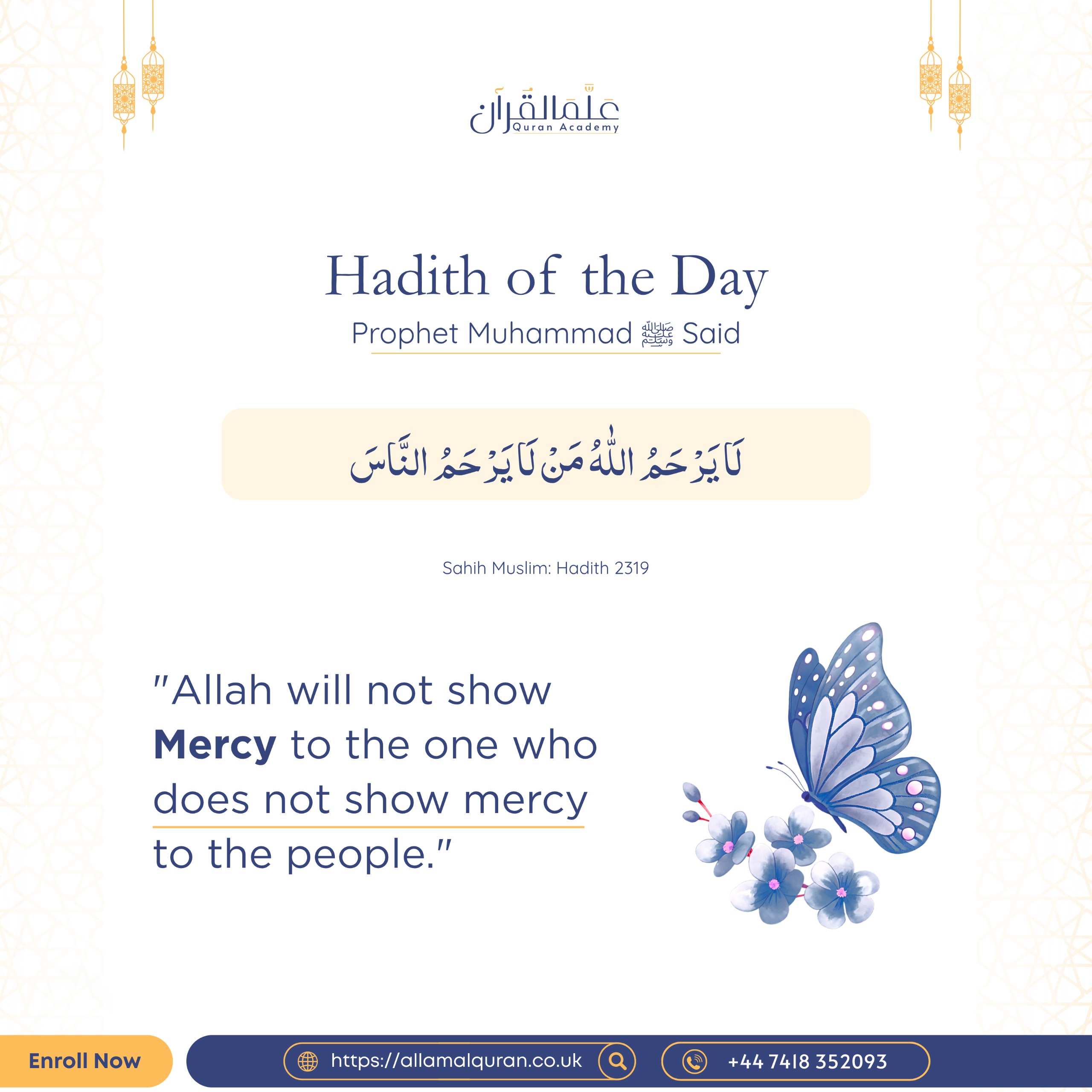
This profound prophetic statement, recorded in Sahih Muslim, condenses the entire ethical framework of Islam into a single, powerful sentence. Mercy (rahmah) is not a passive emotion — it is an active, daily practice that defines a believer's character. The Prophet ﷺ links divine compassion directly to human conduct: if we withhold kindness, forgiveness, or gentleness from those around us, we risk being deprived of Allah’s own mercy. This hadith serves as both a warning and an invitation: a warning against hardness of heart, and an invitation to embody the very attribute that Allah has chosen for Himself.
In a world that often prizes self-interest, the call to mercy is countercultural. Yet the Prophet ﷺ made it clear that mercy is the currency of the Hereafter. Every smile, every word of comfort, every act of patience in the face of annoyance — these are not minor gestures; they are bricks in the edifice of faith. The hadith does not say “Allah will not love” or “will not forgive”; it specifically uses the word “Mercy” — the very essence of divine care. To lose that is to lose a connection with the Most Merciful.
The Arabic root r-ḥ-m carries the meaning of tenderness, womb-like care, and protective love. When the Prophet ﷺ says that Allah will not show mercy to the unmerciful, he is not merely describing a transactional punishment; he is revealing a spiritual law. Just as water flows to the lowest ground, mercy descends upon the merciful. The companions understood this so deeply that they would compete in forgiving others, visiting the sick, and even showing kindness to animals.
Mercy is the lens through which we see others as fellow travelers on the road to God. It transforms judgment into understanding, anger into patience, and selfishness into generosity. The hadith challenges us to examine our daily interactions: Are we quick to condemn? Do we hold grudges? Are we indifferent to the pain of our neighbours? These are the subtle indicators of a heart that may be drifting from divine mercy.
The hadith doesn’t limit mercy to charitable acts; it includes the way we speak, the assumptions we make, and the patience we show under pressure. A merciful person is slow to anger, quick to excuse, and generous in interpretation. The Prophet ﷺ said, “The merciful are shown mercy by the Most Merciful. Be merciful to those on earth, and the One in heaven will have mercy upon you” (Sunan al-Tirmidhī). This chain of mercy is unbroken: our earthly compassion becomes the very vessel through which divine compassion reaches us.
In educational settings, mercy is the foundation of a positive learning environment. A teacher who shows patience with a struggling student, a parent who listens without judgment, a colleague who offers support rather than criticism — these are practical applications of this hadith. The modern world often measures success by productivity, but the Prophet ﷺ measured success by the quality of one’s heart. And a heart that does not tremble with mercy for others is a heart that has forgotten its own need for divine compassion.
ﷺ “Be merciful to those on earth, and the One in heaven will have mercy upon you.”
— Sunan al-Tirmidhī · This companion hadith reinforces the same principle: mercy is a two‑way relationship with the Divine.
As we internalise this hadith, we realise that mercy is not a soft option; it is a demanding discipline. It requires us to overlook faults, to give more than we receive, and to treat every person as a potential recipient of Allah’s grace. The Prophet ﷺ said, “Whoever does not show mercy will not be shown mercy” — and this repetition across multiple narrations underscores its centrality. In our homes, schools, and communities, let this be our measure: not how much we have achieved, but how much we have forgiven; not how powerful we are, but how gentle we have become.
The hadith of the day is a living reminder that our relationship with Allah is mirrored in our relationship with His creation. If we want to be enveloped in the infinite mercy of the Most Merciful, we must open our hearts to those around us — with a smile, a kind word, a helping hand, or even a silent prayer for their wellbeing. This is the path of the Prophet ﷺ, and it is the path that leads to eternal success.