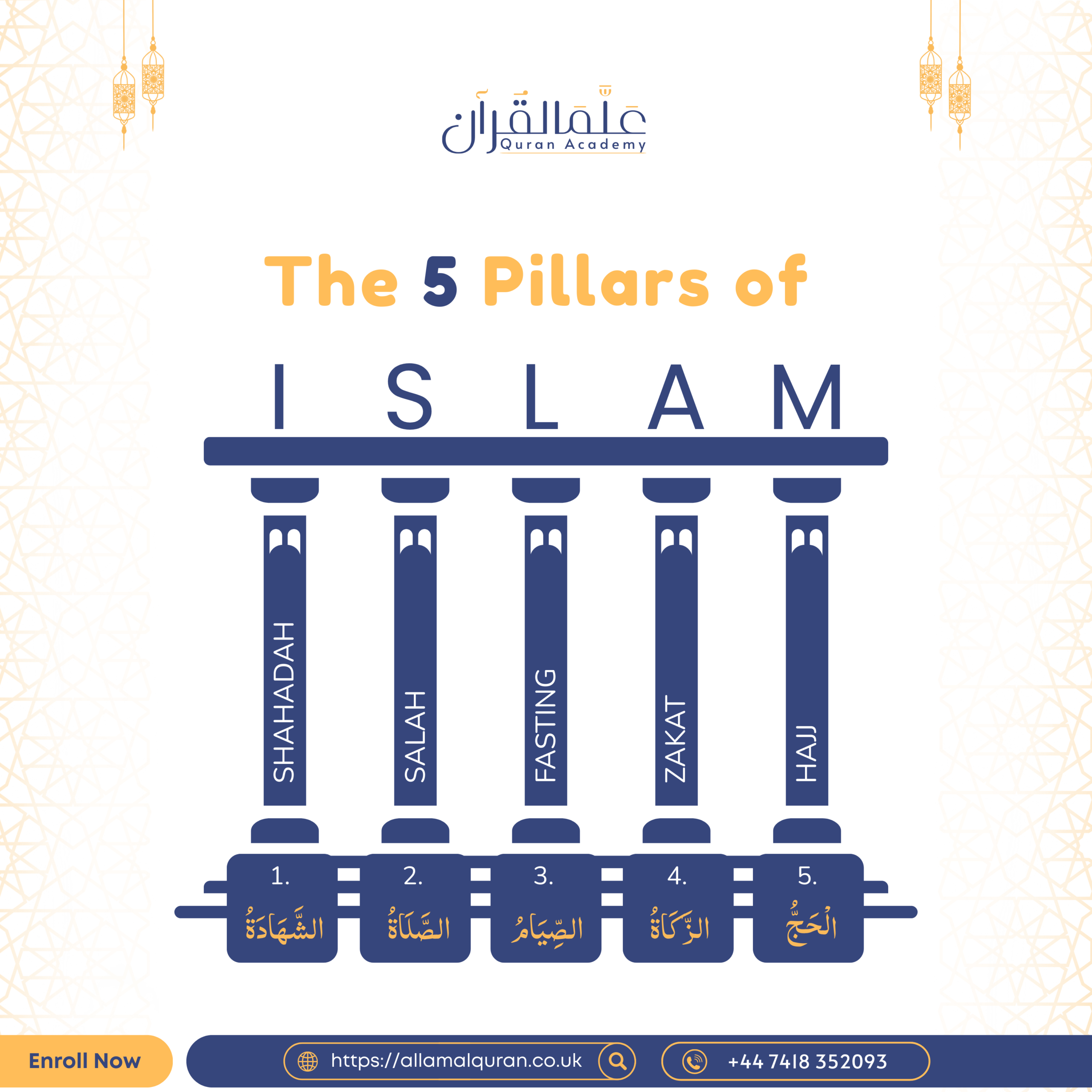
The Five Pillars of Islam form the core framework of a Muslim's faith and practice. These foundational acts of worship are essential to Islamic belief and provide a structured path for spiritual growth, community connection, and personal discipline. At Allamal Quran Academy, we believe in making these essential teachings accessible and understandable for students of all ages and their families.
1 Shahadah (Declaration of Faith)
الشَّهَادَةُ
The Shahadah is the fundamental declaration of Islamic belief, stating "There is no god but Allah, and Muhammad is the Messenger of Allah." This first pillar represents the foundation of Islamic monotheism and acceptance of Prophet Muhammad's teachings. It's not merely a phrase to be recited but a profound commitment that shapes a Muslim's worldview and spiritual identity.
At Allamal Quran Academy, we help students understand the depth and meaning behind this declaration, exploring its theological significance and practical implications in daily life.
2 Salah (Prayer)
الصَّلَاةُ
Performed five times daily, Salah is the structured prayer that connects Muslims directly with Allah. These prayers occur at dawn, midday, afternoon, sunset, and night, providing regular moments of reflection, gratitude, and spiritual realignment throughout the day.
We teach students not only the physical movements and Arabic recitations but also the mindfulness and concentration (khushu) that transforms ritual into genuine spiritual connection. Our teachers emphasize how regular prayer builds discipline and consciousness of the Divine in everyday life.
3 Zakat (Almsgiving)
الزَّكَاةُ
Zakat is the obligatory charitable giving that purifies wealth and supports community welfare. Typically calculated as 2.5% of surplus savings, it represents a social responsibility and economic justice system built into Islamic practice.
Through our programs at Allamal Quran Academy, students learn about the wisdom behind Zakat, its role in reducing inequality, and how it fosters empathy and community solidarity.
4 Sawm (Fasting)
الصِّيَامُ
Observed during the month of Ramadan, fasting from dawn to sunset teaches self-discipline, spiritual reflection, and empathy for those less fortunate. Beyond abstaining from food and drink, fasting encompasses controlling one's thoughts, words, and actions.
We guide students through the physical and spiritual aspects of fasting, helping them appreciate its transformative potential and community-building aspects during Ramadan.
5 Hajj (Pilgrimage)
الْحَجُّ
The pilgrimage to Mecca, required once in a lifetime for those physically and financially able, represents the unity of the global Muslim community. Hajj rituals commemorate the legacy of Prophet Ibrahim and emphasize equality before Allah.
Even for students who may not perform Hajj for years to come, we teach its historical, spiritual, and communal significance, helping them understand its place in Islamic tradition.
Common Questions from Parents & Students
Parent Question: At what age should children begin learning about the Five Pillars?
Teacher Answer: We introduce age-appropriate concepts as early as 5-6 years old, focusing on simple explanations and positive associations. Formal education about obligations typically begins around 7, with practical implementation phased according to maturity and understanding.
Student Question: Why do we pray five times a day specifically?
Teacher Answer: The five daily prayers provide a consistent rhythm to the day, regularly redirecting our attention to spiritual matters amidst worldly activities. Each prayer time corresponds to different phases of the day, offering multiple opportunities for connection, gratitude, and seeking guidance.
Parent Question: How can we make Zakat meaningful for children who don't have their own wealth?
Teacher Answer: Children can participate in Zakat through charitable projects, donating a portion of their allowance, or helping choose family donations. We emphasize the spirit of giving rather than just the monetary aspect, encouraging empathy and awareness of community needs.
Student Question: What if I can't remember all the Arabic words for prayer?
Teacher Answer: This is very common when starting. Begin with what you know, even if it's just a few phrases. We use gradual learning techniques, repetition, and understanding the meanings to help memorization. Allah appreciates the effort, and consistency will improve your recitation over time.
Begin Your Child's Islamic Education Journey
At Allamal Quran Academy, we combine traditional Islamic teaching with modern educational methods. Our qualified teachers provide supportive, engaging lessons that help students understand and connect with their faith.
Explore Our Programs