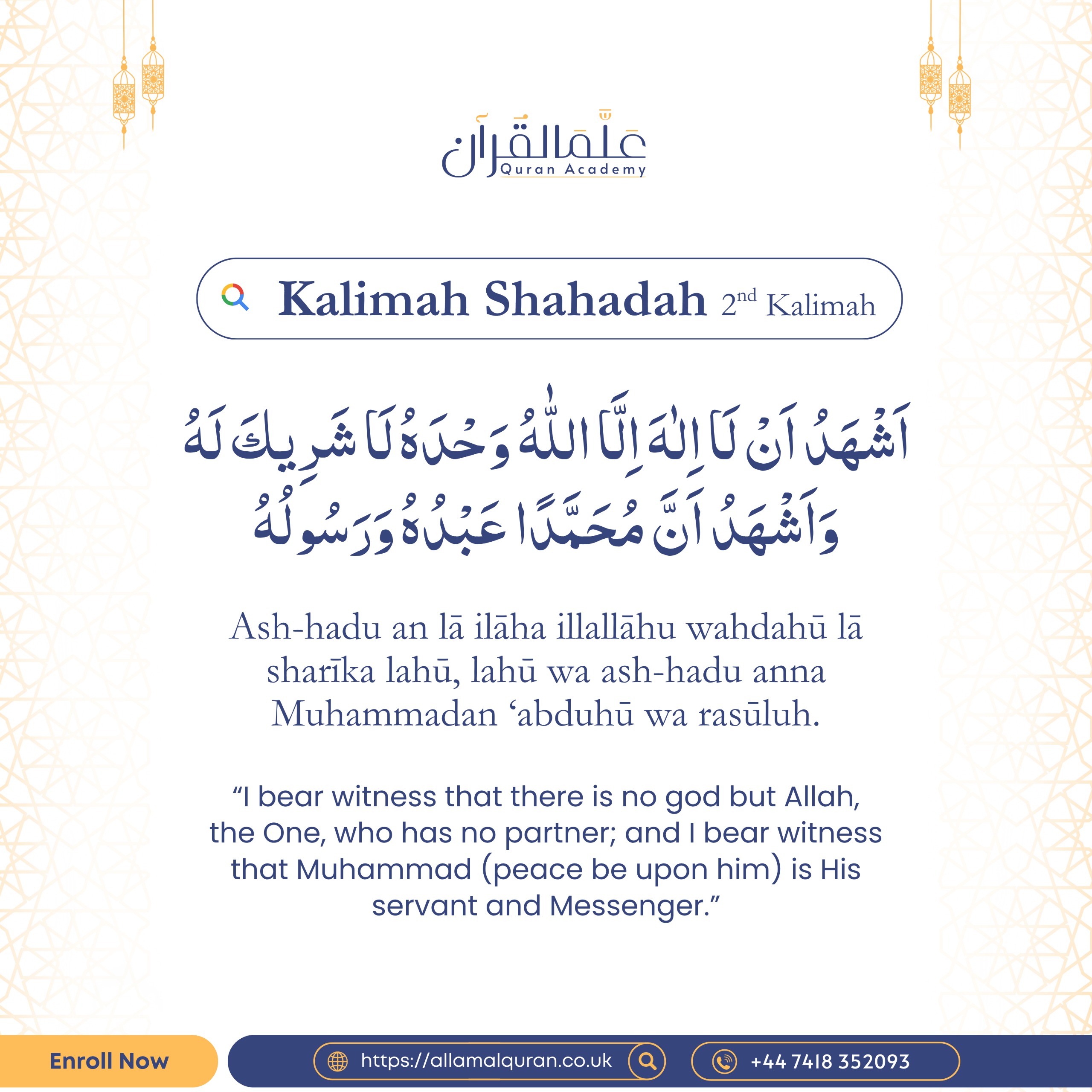
Kalimah Shahadah - 2nd Kalimah
The Comprehensive Declaration of Islamic Faith and Testimony
اَشْهَدُ اَنْ لَا اِلٰهَ اِلَّا اللّٰهُ وَحْدَهُ لَا شَرِيكَ لَهُ وَاَشْهَدُ اَنَّ مُحَمَّدًا عَبْدُهُ وَرَسُولُهُ
Ash-hadu an la ilāha illallāhu wahdahu la sharīka lahu, wa ash-hadu anna Muhammadan ‘abduhu wa rasūluh
"I bear witness that there is no god but Allah, the One, who has no partner; and I bear witness that Muhammad (peace be upon him) is His servant and Messenger."
The Significance of Second Kalimah Shahadah
The Second Kalimah, known as Kalimah Shahadah, represents the complete and detailed testimony of faith in Islam. While the First Kalimah establishes the basic declaration, this Second Kalimah expands upon it with profound additions that deepen our understanding of Tawheed (Islamic monotheism) and the status of Prophet Muhammad (PBUH).
This comprehensive declaration emphasizes Allah's absolute oneness without any partners and specifically describes Prophet Muhammad (PBUH) as both Allah's servant and messenger. This dual description holds significant theological importance, balancing the Prophet's elevated status as Allah's final messenger with his humble position as a servant of Allah.
The Second Kalimah Shahadah reinforces the foundation of Islamic faith while adding deeper layers of understanding about Allah's unity and the Prophet's perfect example.
Key Benefits and Spiritual Rewards
Enhanced Tawheed
Strengthens understanding of Allah's absolute oneness and rejection of any form of shirk (associating partners with Allah)
Complete Testimony
Provides a comprehensive declaration that covers all essential aspects of Islamic faith in one statement
Prophetic Example
Emphasizes following Prophet Muhammad's (PBUH) example as both Allah's messenger and humble servant
Daily Reinforcement
Serves as a powerful daily reminder of Islamic beliefs, strengthening faith and spiritual connection
First vs Second Kalimah: Understanding the Progression
The First Kalimah introduces the basic declaration of faith, while the Second Kalimah expands it with crucial details - emphasizing Allah's absolute oneness and the Prophet's dual role as servant and messenger, providing a more comprehensive understanding of Islamic theology.
Common Questions About Second Kalimah
Parent: What is the main difference between the First and Second Kalimah?
Teacher: The First Kalimah is the basic declaration: "La ilaha illallah Muhammadur Rasulullah." The Second Kalimah expands this by adding "Wahdahu la sharika lahu" (the One, who has no partner) emphasizing Allah's absolute oneness, and "Abduhu wa rasuluh" (His servant and messenger) highlighting Prophet Muhammad's perfect balance of messengership and servitude to Allah.
Parent: Why is it important to describe Prophet Muhammad as both "servant" and "messenger"?
Teacher">This dual description is profoundly important. "Servant" (Abd) emphasizes the Prophet's humility and complete submission to Allah, while "Messenger" (Rasul) acknowledges his special role in delivering Allah's message. This balance prevents exaggeration in honoring the Prophet while maintaining proper respect for his unique position in Islam.
Parent: When should we teach children the Second Kalimah after they learn the First?
Teacher">Once children have mastered the First Kalimah and understand its basic meaning (usually around ages 5-7), you can introduce the Second Kalimah. Start by explaining that this is an "expanded version" that tells us more about Allah's oneness and the Prophet's special role. Teach it gradually, focusing on one new phrase at a time.
Parent: Is there a specific time or situation when reciting the Second Kalimah is particularly recommended?
Teacher">While it can be recited at any time, many Muslims include it in their daily morning and evening adhkar (remembrances). It's particularly beneficial during times of spiritual reflection, when seeking forgiveness, or when wanting to strengthen one's faith. The regular recitation helps internalize the profound concepts it contains.
Parent: How can we help children understand the concept of "no partner" in Allah's divinity?
Teacher">Use simple analogies children can understand. Explain: "Just like you have only one mother and father, Allah is the only God. He doesn't have any helpers or partners in being God. He created everything alone and doesn't need anyone's help." Use examples from their daily life to make the abstract concept tangible.
Teaching the Second Kalimah to Children
1
Build on Foundation: Ensure children have mastered the First Kalimah before introducing the Second, building upon their existing knowledge.
2
Phrase by Phrase: Teach the Kalimah in sections, explaining each new phrase's meaning before moving to the next.
3
Practical Examples: Use real-life examples to explain complex concepts like "no partners" and "servant and messenger."
4
Regular Practice: Incorporate the Second Kalimah into daily Islamic routines, making recitation a natural and regular practice.
Deep Meaning of Key Phrases
"Wahdahu la sharika lahu" - The One, who has no partner
This phrase emphasizes the absolute oneness of Allah:
Wahdahu: Means "He alone" or "the One" - emphasizing Allah's unique and singular nature
La sharika lahu: Means "no partner for Him" - completely rejecting any form of shirk or association of partners with Allah
This represents the purest form of Tawheed, acknowledging that Allah alone deserves worship and has no equals, partners, or competitors in His divinity
"Abduhu wa rasuluh" - His servant and messenger
This description of Prophet Muhammad (PBUH) contains profound wisdom:
Abduhu: "His servant" - emphasizes the Prophet's complete submission and obedience to Allah, setting the example for all Muslims
Wa rasuluh: "And His messenger" - acknowledges his role as the final prophet chosen by Allah to deliver His message
This balanced description prevents both underestimating the Prophet's status and exaggerating it beyond proper Islamic boundaries
Email Now for Comprehensive Islamic Learning Resources and Kalimah Education Guides