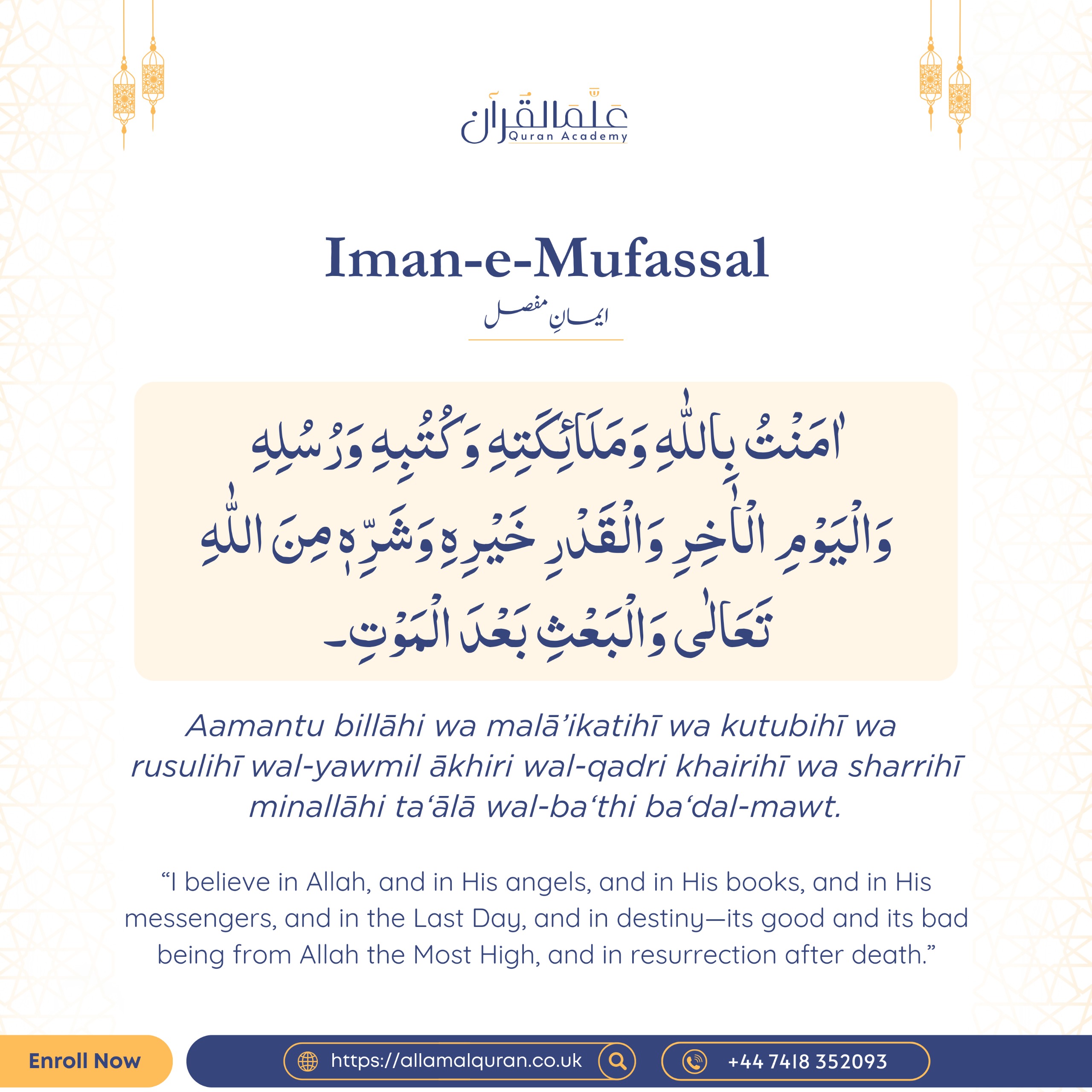
Iman-e-Mufassal

Iman-e-Mufassal

Iman-e-Mufassal: The Detailed Declaration of Faith

A Comprehensive Understanding of Islamic Beliefs and Their Spiritual Significance

Introduction to Iman-e-Mufassal

Iman-e-Mufassal, or the Detailed Declaration of Faith, represents the comprehensive articulation of Islamic beliefs that every Muslim affirms. This detailed creed encompasses the fundamental pillars of faith that form the foundation of Islamic theology and spiritual practice. Unlike Iman-e-Mujmal (the concise declaration), Iman-e-Mufassal elaborates on each component of belief, providing a complete framework for understanding the relationship between the Creator, creation, and the unseen world.

The importance of Iman-e-Mufassal extends beyond mere recitation; it serves as a constant reminder of the comprehensive nature of Islamic faith, guiding Muslims in their daily lives, ethical decisions, and spiritual development. Understanding each component strengthens one's connection with Allah and provides clarity about the purpose of existence.

The Complete Text of Iman-e-Mufassal

اٰمَنْتُ بِاللّٰهِ وَمَلَائِکَتِهِ وَکُتُبِهِ وَرُسُلِهِ وَالْیَوْمِ الْاٰخِرِ وَالْقَدْرِ خَیْرِهِ وَشَرِّهٖ مِنَ اللّٰهِ تَعَالٰی وَالْبَعْثِ بَعْدَ الْمَوْتِ۔
English Translation:

"I believe in Allah, His Angels, His Books, His Messengers, the Day of Judgment, and that fate, both good and bad, is from Allah the Almighty, and in the resurrection after death."

This declaration systematically outlines the essential beliefs of Islam, serving as a complete theological framework. Each component represents a fundamental aspect of Islamic faith that Muslims are required to believe in with conviction and without doubt.

The Seven Pillars of Iman in Detail

1

Belief in Allah

Faith in the One God, affirming His existence, oneness, and absolute sovereignty over all creation. This includes belief in His perfect attributes and names as described in the Quran.

2

Belief in Angels

Acknowledgment of angels as spiritual beings created from light who faithfully execute Allah's commands, recording deeds, delivering revelations, and administering the universe.

3

Belief in Divine Books

Acceptance of all scriptures revealed by Allah, including the Quran, Torah, Gospel, and Psalms, recognizing the Quran as the final, preserved, and complete guidance.

4

Belief in Prophets

Faith in all messengers sent by Allah, from Adam to Muhammad (peace be upon them all), acknowledging their truthfulness and accepting their teachings.

5

Belief in the Day of Judgment

Conviction in the resurrection, accountability, divine justice, and the eternal consequences of one's beliefs and actions in this worldly life.

6

Belief in Divine Decree

Acceptance that everything, good and bad, occurs by Allah's will and knowledge, while maintaining responsibility for one's choices and actions.

7

Belief in Resurrection

Faith in life after death, when all beings will be resurrected, judged according to their deeds, and assigned to their eternal abodes.

Educational Dialogue: Questions from Parents & Answers from Teachers

How can I explain the concept of belief in angels to my young children in a way they can understand?
Begin with the concept of unseen helpers who follow Allah's commands perfectly. Use simple analogies: just as we have teachers in school, Allah has angels who help run the universe. Explain that each person has two angels who record good and bad deeds, emphasizing this teaches honesty and mindfulness. For younger children, focus on angels as protectors and helpers rather than delving into complex theological concepts.
What's the practical significance of believing in Divine Decree (Qadar) in daily life?
Belief in Qadar provides emotional resilience and spiritual balance. It teaches Muslims to exert maximum effort while accepting outcomes as part of Allah's wisdom. This belief prevents despair during difficulties and arrogance during success. Practically, it means working hard for your exams while accepting the results with grace, striving for career success while understanding ultimate provision comes from Allah, and facing health challenges with patience and treatment.
How does Iman-e-Mufassal differ from Iman-e-Mujmal, and which should be taught first?
Iman-e-Mujmal is the concise declaration: "I believe in Allah as He is with His names and attributes, and I accept all His commandments." It's shorter and more general. Iman-e-Mufassal is detailed, specifying each pillar. For children, begin with Iman-e-Mujmal around age 6-7, then introduce Iman-e-Mufassal gradually from age 9-10, explaining each pillar with age-appropriate examples. Both are essential, with Mufassal providing the comprehensive understanding needed as children mature.
Why is belief in all previous scriptures important if we follow the Quran?
Belief in all divine scriptures establishes continuity of revelation and respect for earlier prophets and their communities. It acknowledges that Allah guided humanity progressively, with each scripture suited to its time and people. The Quran, as the final revelation, confirms truths in previous scriptures while correcting alterations and completing the message. This belief fosters interfaith respect while maintaining conviction in Islam as the final, preserved guidance.
How can we make the concept of the Day of Judgment meaningful for teenagers?
Connect it to their experiences of justice and accountability. Discuss how every action creates a consequence - similar to academic effort resulting in grades, but on an eternal scale. Emphasize that belief in accountability promotes ethical behavior even when no one is watching. Use contemporary examples: digital footprints that remain forever illustrate how deeds are recorded. Focus on the positive aspect - ultimate justice for oppression and reward for patience and good deeds.

Spiritual Benefits of Understanding Iman-e-Mufassal

  • Strengthened Faith: Comprehensive understanding deepens conviction and protects against doubts
  • Holistic Worldview: Integrates spiritual and physical realities into a coherent perspective
  • Emotional Resilience: Belief in Qadar provides comfort during difficulties and humility during success
  • Moral Foundation: Accountability on the Day of Judgment encourages ethical conduct
  • Purposeful Living: Understanding creation's purpose guides life decisions and priorities
  • Community Unity: Shared beliefs create strong bonds among Muslims worldwide
  • Intellectual Satisfaction: Answers fundamental questions about existence, purpose, and destiny

Implementation in Daily Life

The true test of Iman-e-Mufassal lies in its practical implementation. Belief in Allah translates to worship and reliance; belief in angels leads to consciousness of being constantly observed; belief in scriptures means regular Quranic engagement; belief in prophets inspires emulation of their character; belief in the Hereafter prioritizes eternal over temporary gains; belief in Qadar combines effort with acceptance.

Daily recitation of Iman-e-Mufassal, preferably during morning and evening remembrances, reinforces these beliefs. Parents should explain each component to children using age-appropriate language, connecting abstract concepts to tangible examples from daily life. Educational institutions should incorporate systematic teaching of Islamic creed, ensuring students understand not just what to believe, but why these beliefs matter.

Ultimately, Iman-e-Mufassal serves as both a theological framework and a practical guide, shaping worldview, behavior, and spiritual development. Its comprehensive nature addresses the intellectual, emotional, and practical dimensions of faith, making it relevant to Muslims in every era and circumstance.