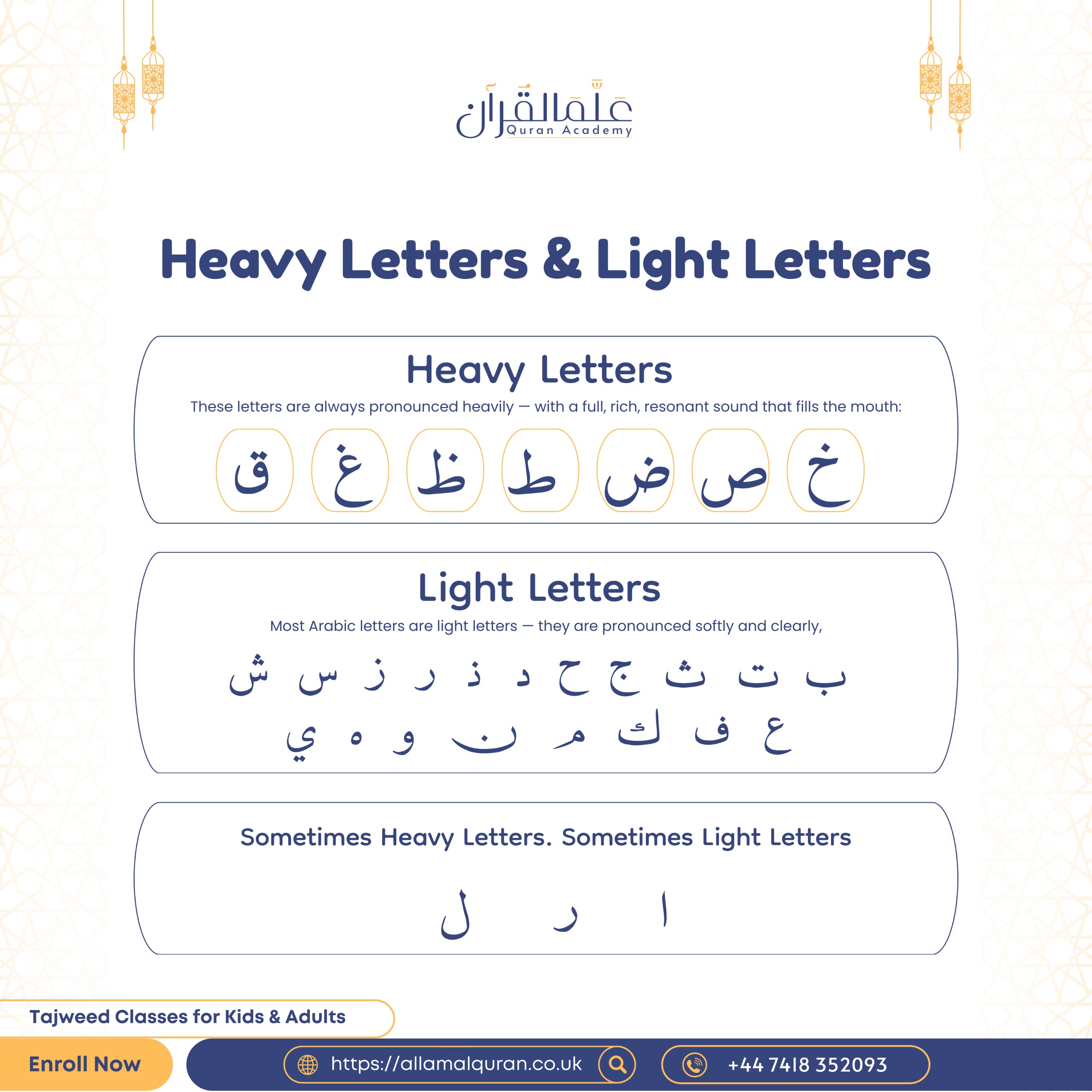
Heavy Letters & Light Letters

Heavy Letters & Light Letters

Heavy & Light Letters: Essential Tajweed Rules for Quranic Recitation

A comprehensive professional guide to understanding Tafkheem (Heaviness) and Tarqeeq (Lightness) in Arabic pronunciation

The Foundation of Quranic Pronunciation

In the sacred science of Tajweed, the distinction between Heavy Letters (Huroof al-Tafkheem) and Light Letters (Huroof al-Tarqeeq) forms a critical pillar of proper Quranic recitation. This phonetic differentiation isn't merely technical—it preserves the divine text's meaning, rhythm, and spiritual resonance.

Tafkheem (تغخيم) linguistically means "to make thick or heavy," referring to letters that require full mouth resonance. Tarqeeq (ترقيم) means "to make thin or light," describing letters pronounced with minimal mouth cavity engagement. Mastering this distinction separates mechanical reading from spiritually impactful tilawah.

Physical Pronunciation Guide

1
Heavy Letters

Elevate tongue back, engage throat muscles

2
Light Letters

Keep tongue forward, relax throat

3
Mouth Shape

Round lips for heaviness, neutral for lightness

Heavy Letters (Tafkheem)

خ ص ض غ ط ق ظ

The 7 Always-Heavy Letters: Memorize the phrase "خص ضغط قظ" (Khusu Digh'ti Qadh). These letters maintain heaviness regardless of vowel marks.

Characteristics: Full mouth resonance, elevated tongue back, rounded lips, throat engagement. Creates a booming, resonant sound that carries weight and authority.

Light Letters (Tarqeeq)

ح س ك ف ت د ذ ز ش ث ن ل

Majority of Arabic Letters: Most letters default to lightness unless affected by specific conditions.

Characteristics: Delicate pronunciation, forward tongue position, relaxed throat, neutral lip shape. Produces clear, precise sounds without unnecessary weight.

Conditional Letters & Special Cases

Certain letters exhibit variable characteristics based on phonetic context:

Advanced Rule: The Letter Raa (ر)

The letter ر follows specific rules: Heavy with Fatha or Damma, Light with Kasra, and medium when preceded by Kasra and followed by a heavy letter. This nuanced application demonstrates Tajweed's sophistication.

The letter Alif Maddiyyah inherits characteristics from preceding letters. The majestic Laam in "Allah" becomes heavy when preceded by Fatha or Damma—a rule with profound spiritual implications regarding the Divine Name's pronunciation.

Expert Q&A: Tajweed Teachers Address Parent Concerns

Parent: My child can identify heavy/light letters but struggles with application during continuous recitation. Is this normal? +
Senior Tajweed Teacher Ustadh Ahmed Hassan

Absolutely normal. There are three developmental stages: Cognitive (recognizing rules), Associative (applying with effort), and Autonomous (automatic application). Most students require 4-8 months of consistent practice to reach autonomy. I recommend "chunking" practice—focus on 2-3 verse segments repeatedly until mastery before progressing. Record and compare weekly to track improvement.

Parent: Are digital Tajweed apps effective for learning these distinctions, or should we stick to traditional teacher-led instruction? +
Tajweed Methodology Expert Dr. Fatima Al-Mansouri

Blended learning yields optimal results. Use apps for reinforcement—particularly those with spectral analysis showing resonance patterns—but maintain live teacher sessions for correction. The human ear detects subtleties software might miss. I recommend 70% teacher-led instruction, 20% app-assisted practice, 10% self-recording analysis. This balanced approach respects tradition while leveraging technology.

Parent: How critical is mastering this distinction for Quranic comprehension? Can't we focus on meaning first? +
Quranic Linguistics Scholar Professor Khalid Ibrahim

Profoundly critical. Consider the semantic difference between قَبْر (grave) with heavy Qaf and كَبْر (arrogance) with light Kaf. Pronunciation changes meaning entirely. Tajweed preserves divine intent. While meaning is essential, correct pronunciation ensures you're engaging with the actual revealed words, not approximations. Parallel-track learning—gradually improving pronunciation while studying meaning—is most effective.

Parent: What's the optimal practice routine for an intermediate student aiming to perfect heavy/light letter application? +
Tajweed Curriculum Director Shaykh Omar Farouk

Implement the "Triple-R Method": 15 minutes of Rule Review (theoretical study), 20 minutes of Repetitive Practice (focused ayahs with target letters), 10 minutes of Recitation Recording with self-analysis. Target Surahs like Al-Fatiha, Al-Ikhlas, and Al-Falaq which contain excellent examples. Monthly teacher evaluation is crucial. Consistency—20 minutes daily—outperforms 2-hour weekly sessions.

Practical Application Exercises

قَلْبٌ
Heart (Heavy Qaf)
كَلْبٌ
Dog (Light Kaf)
غَفُورٌ
All-Forgiving (Heavy Ghayn)
حَفِيظٌ
Protector (Light Ha)

Common Professional Pitfalls & Solutions

Pitfall 1: Exaggerated Heaviness - Transforming beautiful resonance into harsh guttural sounds. Solution: Practice with moderate volume, focusing on mouth cavity space rather than throat force.

Pitfall 2: Inconsistent Application - Applying rules randomly. Solution: Create a checklist of the 7 always-heavy letters and review before each recitation session.

Pitfall 3: Neglecting Vowel Effects - Ignoring how Fatha adds slight heaviness. Solution: Practice minimal pairs with different vowelizations to develop sensitivity.

Professional Tip: The Mirror Technique

Practice before a mirror. Heavy letters visibly round the lips and expand the mouth cavity. Light letters maintain neutral facial posture. This visual feedback accelerates muscle memory development.