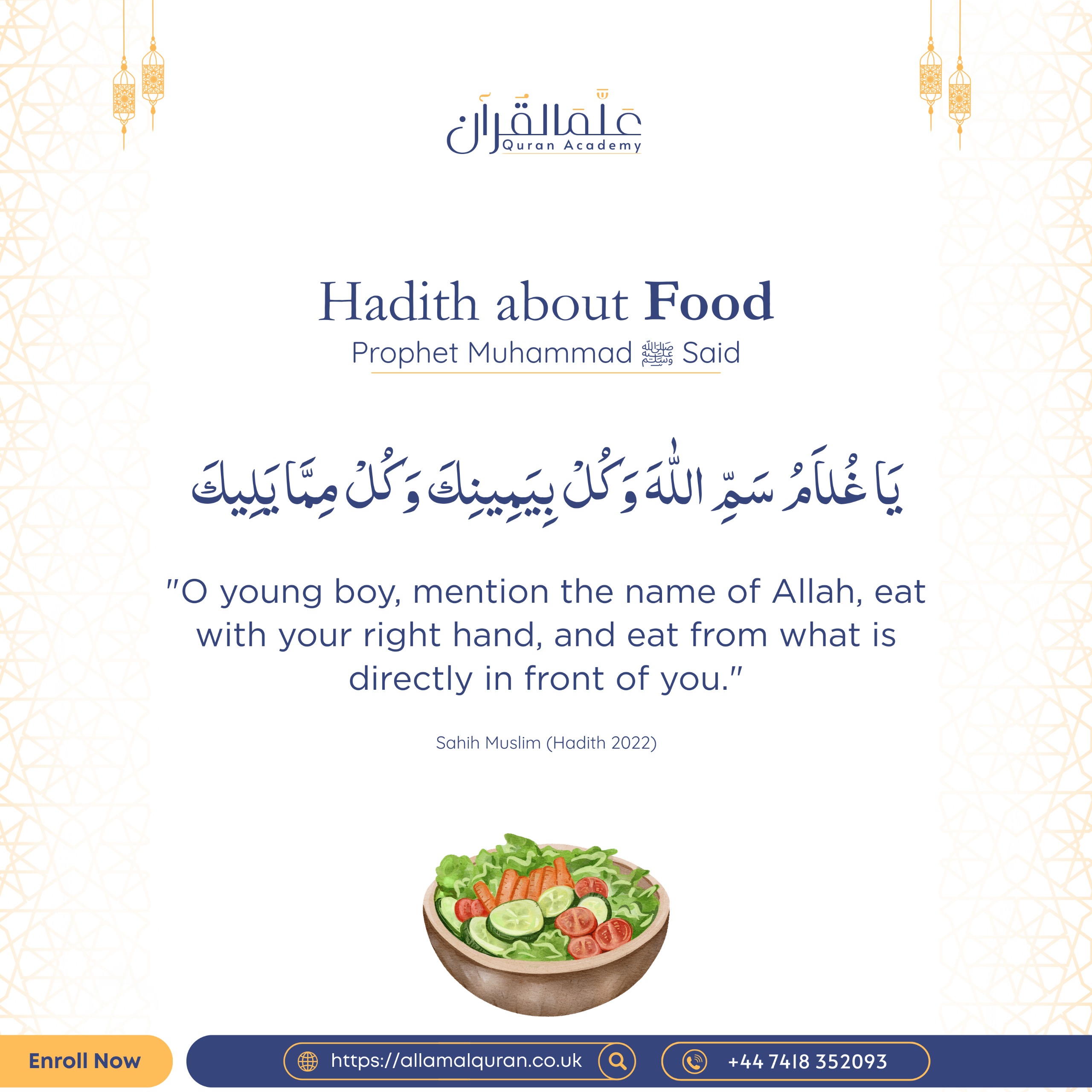
"O young boy, mention the name of Allah, eat with your right hand, and eat from what is directly in front of you."
Sahih Muslim (Hadith 2022)
The Comprehensive Wisdom Behind Food Etiquette
The teachings of Prophet Muhammad (peace be upon him) encompass every aspect of human life, including the seemingly mundane act of eating. This particular hadith, narrated in Sahih Muslim, provides profound guidance that extends beyond mere ritual to touch upon spiritual, social, and psychological dimensions of human existence.
Three Pillars of Prophetic Eating Etiquette
This hadith establishes three fundamental principles: beginning with Allah's name, using the right hand, and eating from what is nearest. Each element carries significant wisdom that modern science and psychology continue to validate.
The context of this teaching is particularly noteworthy. The Prophet addressed a young companion during a meal, demonstrating that Islamic education occurs in real-life situations. This pedagogical approach ensures that lessons are practical, memorable, and immediately applicable.
Spiritual and Psychological Dimensions
Beginning with "Bismillah" (In the name of Allah) transforms a biological act into worship. This remembrance creates mindfulness, gratitude, and acknowledgment that sustenance ultimately comes from the Divine. Contemporary mindfulness practices echo this principle, emphasizing conscious attention during eating for better digestion and satisfaction.
The instruction to eat with the right hand carries both symbolic and practical significance. Symbolically, the right hand represents purity, blessings, and good deeds in Islamic tradition. Practically, this creates discipline and distinguishes human eating behavior from that of animals, elevating the act to one of conscious choice rather than instinct alone.
Questions from Parents & Answers from Teachers
Why is starting with Allah's name so important for children during meals?
Beginning with Allah's name establishes a spiritual framework for nourishment. It teaches children gratitude, mindfulness, and recognition that sustenance is a blessing. This practice also serves as a protective measure according to Islamic tradition, ensuring that the food is blessed and that any negative spiritual influences are kept away. For children, this routine creates positive associations with food and reinforces their Islamic identity.
How do we practically implement the "eat from what is in front of you" rule in modern family settings?
This teaching promotes several virtues: contentment, manners, and consideration for others. In practice, parents should serve food in a way that each person has accessible portions directly before them. Teach children not to reach across others' plates or take the choicest pieces for themselves. This cultivates patience, respect for shared resources, and social awareness. In buffet settings, the principle translates to taking modest portions and being mindful of others waiting.
What if a child is left-handed? Should we still insist on the right hand?
Islamic scholars have addressed this with nuance. For naturally left-handed children, gentle encouragement to use the right hand for eating is recommended, but not to the point of causing distress or difficulty. The objective is to cultivate the Prophetic practice while being considerate of individual differences. Training can occur gradually, focusing on the spiritual intention behind the action rather than mere ritual compliance.
How does this etiquette relate to modern health and nutrition science?
Remarkably, this 1,400-year-old guidance aligns with contemporary health principles. Eating mindfully (starting with Allah's name) improves digestion and prevents overeating. Using one hand naturally slows the eating pace, allowing satiety signals to reach the brain. Eating from what's directly in front encourages portion awareness. Together, these practices promote healthier eating habits, better digestion, and more enjoyable mealtime experiences validated by nutritional science.
Implementing Prophetic Teachings in Contemporary Life
The timeless nature of Prophetic guidance lies in its adaptability to different cultures and eras. In today's fast-paced world, where meals are often rushed or consumed alone, this hadith offers corrective wisdom. Families can create "device-free" meal times where the focus is on mindful eating, gratitude, and connection—both with each other and with the Divine.
The Social Dimension of Eating
The hadith implicitly emphasizes communal eating etiquette. By eating from one's own section and using proper manners, the meal becomes a harmonious social experience rather than a competitive or inconsiderate one. This fosters family bonds and teaches children essential social skills.
Deepen Your Understanding of Islamic Teachings
Join our comprehensive courses on Prophetic traditions, Quranic studies, and Islamic etiquette. Learn with qualified scholars and connect with a community dedicated to authentic Islamic knowledge.
Enroll Now in Our Islamic Studies Program
Contact: +44 7418 352093 | Allama Quran Academy