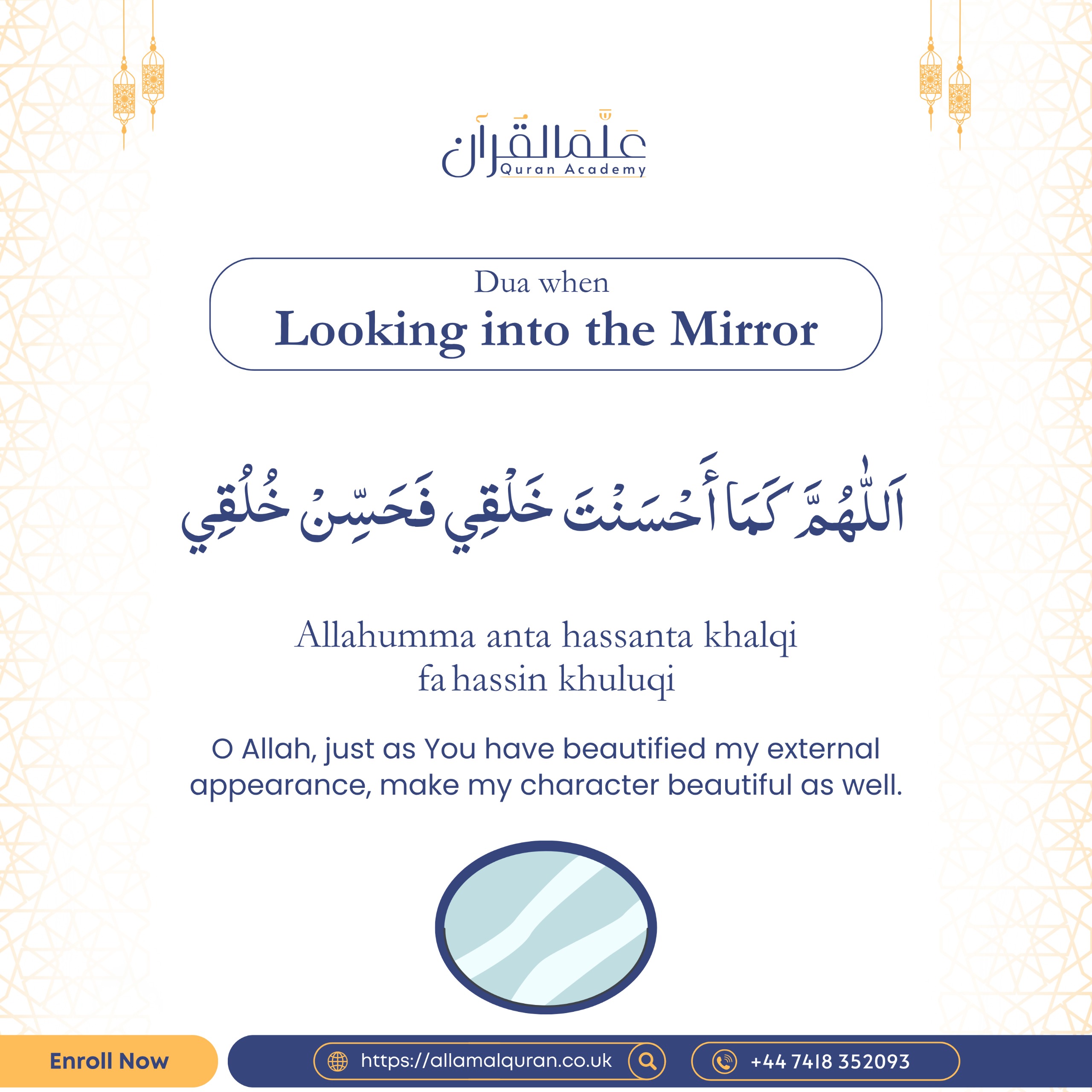
Dua When Looking into the Mirror
Seeking Inner Beauty to Match Outer Appearance
اَللّٰهُمَّ كَمَا أَحْسَنْتَ خَلْقِي فَحَسِّنْ خُلُقِي
Allahumma anta hassanta khalqi fa hassin khuluqi
"O Allah, just as You have beautified my external appearance, make my character beautiful as well."
The Spiritual Wisdom of Mirror Dua
The dua when looking into the mirror represents a profound Islamic practice that transforms a daily routine into a spiritual opportunity for self-improvement. This beautiful supplication, taught by the Prophet Muhammad (PBUH), reminds us that true beauty lies not only in physical appearance but more importantly in the beauty of one's character and moral conduct.
When we recite this dua while seeing our reflection, we acknowledge Allah as the Creator of our physical form while simultaneously asking Him to perfect our inner qualities. This practice establishes a balanced perspective on self-image, recognizing both our external appearance as Allah's creation and our responsibility to develop noble character traits.
Every glance in the mirror becomes an opportunity to seek spiritual refinement and character development through this beautiful Islamic practice.
Benefits of Reciting the Mirror Dua
Balanced Self-Perception
Maintains a healthy balance between appreciating physical appearance and prioritizing character development
Spiritual Awareness
Transforms routine activities into conscious worship and remembrance of Allah throughout the day
Character Development
Actively seeks improvement in moral qualities, manners, and interpersonal relationships
Gratitude Practice
Acknowledges Allah's blessing in physical creation while seeking further spiritual blessings
Islamic Perspective on Beauty
In Islam, true beauty encompasses both external appearance (khalq) and internal character (khuluq). While physical beauty is a blessing from Allah, character beauty is an achievement through conscious effort and divine assistance.
Common Questions About Mirror Dua
Parent: At what age should we start teaching children this mirror dua?
Teacher: Children can begin learning this dua as early as 3-4 years old when they start recognizing themselves in mirrors. Start by reciting it together when you help them get ready. Explain in simple terms: "We thank Allah for making us look nice, and we ask Him to help us be good and kind people too."
Parent: How can we explain the difference between "khalq" and "khuluq" to children?
Teacher">Use simple language: "Khalq is how Allah made us look on the outside - our face, hair, eyes. Khuluq is how we behave - being kind, honest, sharing, and saying nice words." Use practical examples: "When we look in the mirror, we see our khalq. When we help someone, that's showing our khuluq."
Parent: What if we forget to recite the dua until after we've already looked in the mirror?
Teacher">You can still recite it when you remember. The mercy of Allah encompasses our forgetfulness. The important thing is the intention to remember Allah during daily activities. You can also make it a habit to recite it when you approach the mirror, before even looking at your reflection.
Parent: Are there specific character traits we should emphasize when teaching this dua?
Teacher">Focus on the character traits emphasized in the Quran and Sunnah: honesty, kindness, patience, gratitude, humility, and good manners. Explain that beautiful character means being truthful even when it's hard, sharing with others, saying please and thank you, and treating everyone with respect.
Parent: How can we make this practice meaningful for teenagers concerned about appearance?
Teacher">For teenagers, emphasize that this dua helps maintain a healthy self-image. Explain that while it's natural to care about appearance, what truly matters is developing a beautiful character that makes people respect and admire them for who they are, not just how they look. Connect it to building meaningful relationships.
Implementing Mirror Dua in Daily Life
1
Consistent Practice: Make it a habit to recite this dua every time you look in the mirror, whether at home, work, or in public restrooms.
2
Family Participation: Recite it together as a family when getting ready in the morning, turning it into a shared spiritual practice.
3
Reflective Moment: Use the mirror moment not just for recitation but for brief self-reflection on character improvement.
4
Practical Application: After reciting, consciously work on displaying beautiful character throughout the day.
Beautiful Character in Islamic Teachings
Qualities of Beautiful Character (Husn al-Khuluq)
The Prophet Muhammad (PBUH) emphasized several key character traits that constitute beautiful character:
Truthfulness (Sidq): Being honest in speech and actions, even when difficult
Patience (Sabr): Remaining steadfast during challenges and difficulties
Generosity (Karim): Sharing with others and being giving in nature
Humility (Tawadu): Being modest and avoiding arrogance
Forgiveness (Afw): Pardoning others and letting go of grudges
Good Manners (Adab): Displaying proper etiquette in all situations
These qualities represent the "beautiful character" we seek through this dua, transforming our internal state to reflect the beauty Allah has given us externally.
Enroll Now for Comprehensive Islamic Character Development Programs