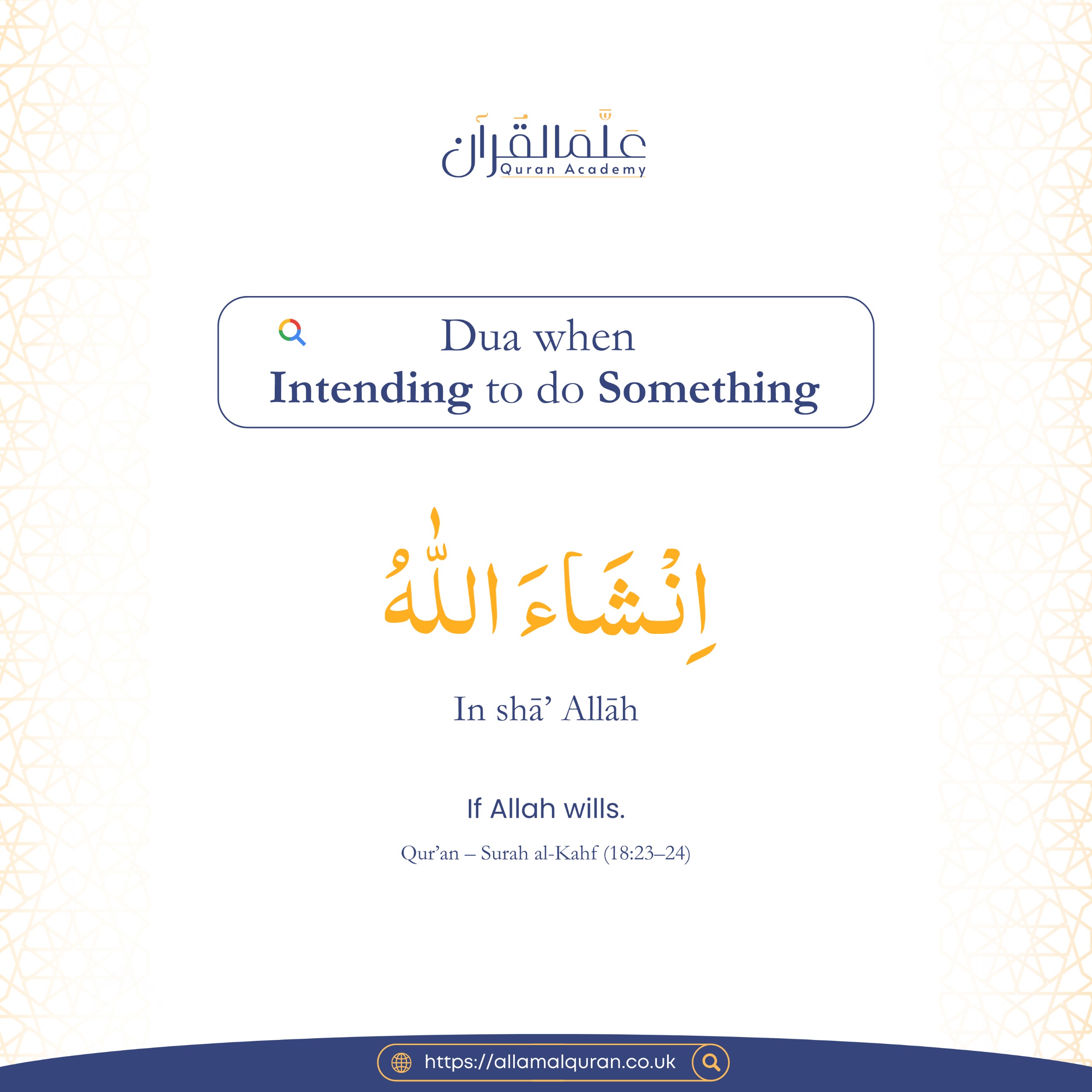
Dua When Intending To Do Something

Dua When Intending to do Something

Intending to do something: The Power of Saying "If Allah Wills"

Exploring the deep meaning and importance of this fundamental Islamic phrase

"And never say of anything, 'Indeed, I will do that tomorrow,' except [when adding], 'If Allah wills.'" (Quran, Surah Al-Kahf, 18:23-24)

The Meaning and Significance of Insha'Allah

The Arabic phrase "Insha'Allah" (إن شاء الله) translates to "If Allah wills" or "God willing." It is derived from the Quranic commandment in Surah Al-Kahf, where Muslims are instructed to always couple their intentions for future actions with this expression of submission to Divine will.

Why Insha'Allah Matters

Using Insha'Allah is not merely a cultural habit but a profound spiritual practice that:

  • Recognizes Allah's ultimate control over all affairs
  • Prevents arrogance and self-reliance
  • Cultivates humility and dependence on God
  • Aligns our intentions with Islamic teachings
  • Reminds us of the uncertainty of the future

Proper Usage in Daily Life

Insha'Allah should be used sincerely whenever speaking about future plans or intentions. This includes:

  • Making appointments or meetings
  • Planning projects or travels
  • Setting personal goals
  • Promising to complete tasks
  • Discussing future aspirations

The practice teaches Muslims to balance initiative and planning with spiritual humility, acknowledging that while we make efforts, the ultimate outcome rests with Allah.

Teaching Children About Insha'Allah

Age-Appropriate Lessons

Children can begin learning about Insha'Allah from a young age through simple explanations and modeling:

  • Ages 3-5: Introduce as a special phrase we say when talking about tomorrow
  • Ages 6-8: Explain that Allah helps our plans happen
  • Ages 9-12: Discuss the Quranic origin and deeper meaning
  • Teens: Explore philosophical dimensions of free will vs. divine decree

Practical Activities

  • Create "Insha'Allah reminder" cards for their room
  • Practice using it in family conversations
  • Share stories from the Prophet's life (peace be upon him)
  • Role-play scenarios where Insha'Allah is appropriate

Common Mistakes to Avoid

  • Using it as a polite way to say "no"
  • Saying it without genuine intention
  • Forgetting to make actual effort after saying it
  • Not explaining the meaning to children

Questions from Parents & Answers from Teachers

How do I explain to my child why we sometimes don't do things we said "Insha'Allah" we would do? +

This is an important teaching moment. Explain that Allah knows what is best for us, and sometimes what we want might not be good for us or the timing isn't right. Use simple examples: "Remember when you really wanted to go to the park, but it rained? Allah knew the rain would help the plants grow, and we can go another day instead." Emphasize that we accept Allah's plan with patience and gratitude.

My teenager says using "Insha'Allah" is just superstition. How should I respond? +

This is a common concern as children develop critical thinking skills. Explain that Insha'Allah is the opposite of superstition - it's based on clear Quranic guidance and recognizes reality: we truly don't control the future. Compare it to scientific humility where researchers acknowledge the limits of their knowledge. Share that many successful Muslims in science, business, and arts use Insha'Allah while achieving great things - it's about attitude, not capability.

At what age should children consistently use "Insha'Allah" correctly? +

Most children begin using Insha'Allah meaningfully between ages 5-7, but consistency develops gradually. Don't force perfection - gently remind them and model correct usage yourself. Praise their efforts when they remember naturally. By age 10, most children should understand the concept and use it appropriately in most situations, though occasional reminders may still be needed.

How can I make learning about "Insha'Allah" engaging for young children? +

Turn it into a game! Create "Insha'Allah stars" where they get a star each time they remember to use it. Read children's books that incorporate the phrase. Use puppets or toys to act out scenarios. Sing simple nasheeds that include Insha'Allah. The key is making it natural and positive rather than a chore or correction.

Is it appropriate to use "Insha'Allah" in professional or non-Muslim settings? +

Yes, absolutely. You can use the English translation "God willing" if that feels more comfortable. Many people of various faiths appreciate this expression of humility. In professional settings, it demonstrates thoughtful planning and recognition that circumstances can change. It often earns respect rather than causing confusion when explained simply as acknowledging that outcomes depend on factors beyond our control.

Deepen Your Family's Islamic Knowledge

Join Quran Academy's family program to learn more about implementing Islamic values in daily life through engaging, age-appropriate lessons for children and guidance for parents.

Explore Our Programs