
Understanding the profound meaning behind the prayer for breaking the fast during Ramadan
Breaking the fast (Iftar) during Ramadan is not merely a physical act of nourishment but a profound spiritual moment in a Muslim's day. The Dua for Iftari encapsulates the essence of fasting—submission, gratitude, and complete reliance on Allah. This supplication, recited when breaking the fast at sunset, transforms a routine action into an act of worship.
The Iftari Dua serves as a reminder that fasting is undertaken solely for Allah's pleasure, reinforcing the believer's faith and trust in divine providence. Each phrase carries deep theological significance, connecting the physical act of breaking the fast with spiritual consciousness.
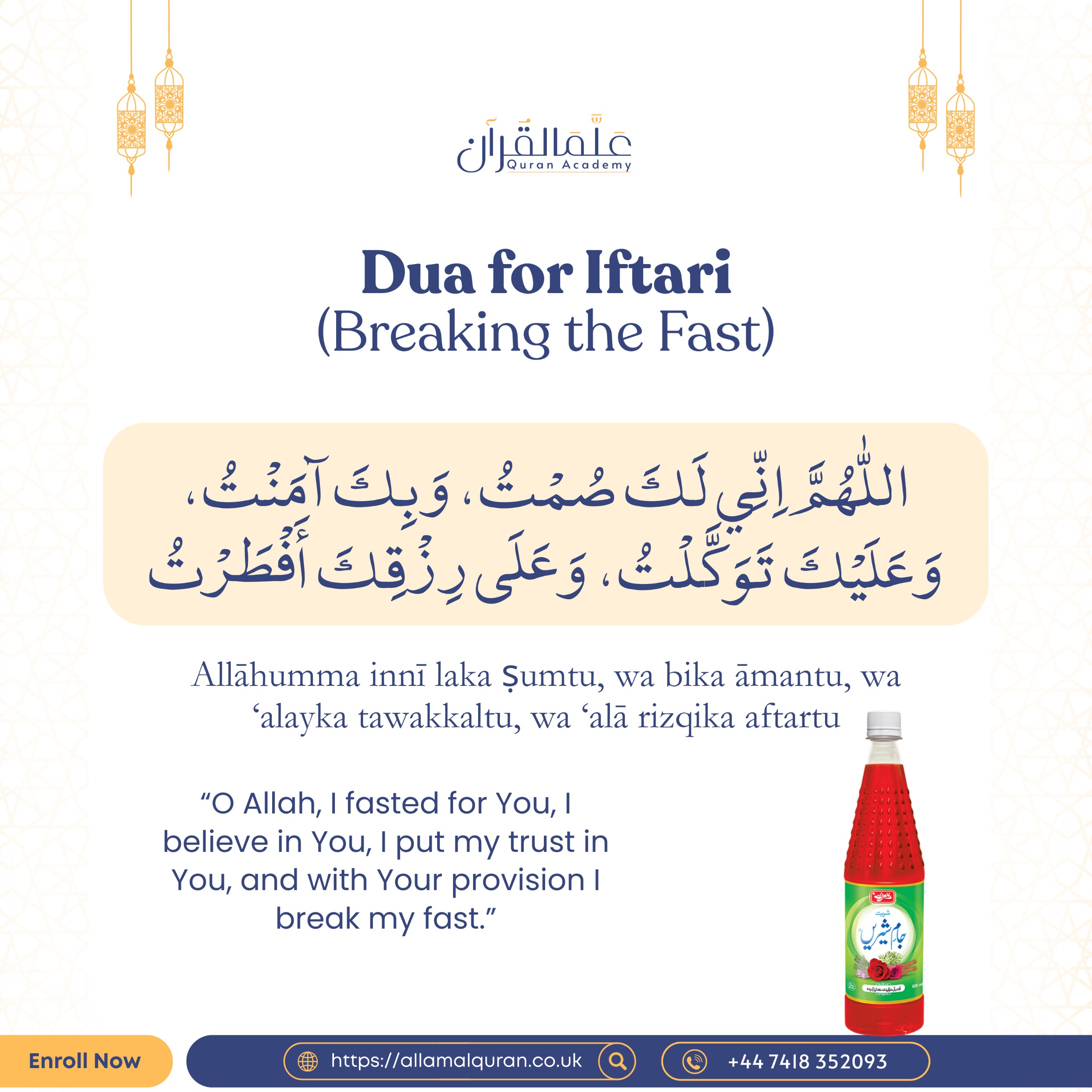
اللَّهُمَّ إِنِّي لَكَ صُمْتُ، وَبِكَ آمَنْتُ، وَعَلَيْكَ تَوَكَّلْتُ، وَعَلَى رِزْقِكَ أَفْطَرْتُ
Allahumma innī laka ṣumtu, wa bika āmantu, wa 'alayka tawakkaltu, wa 'alā rizqika aftartu
"O Allah, I fasted for You, I believe in You, I put my trust in You, and with Your provision I break my fast."
Audio helps with proper pronunciation and memorization.
This opening declaration affirms that the fasting was performed with sincere intention (niyyah) purely for Allah's pleasure, not for show or habit. It establishes the spiritual purpose behind the physical act.
This phrase reinforces the foundation of faith (iman) upon which all acts of worship rest. It connects the specific act of fasting to the broader framework of Islamic belief.
This expresses complete reliance (tawakkul) on Allah, acknowledging that both the ability to fast and the provision to break the fast come from divine grace alone.
This final phrase recognizes that the food and drink consumed are blessings from Allah. It cultivates gratitude and prevents taking sustenance for granted.
Common questions about teaching and practicing the Iftari Dua, answered by experienced Islamic educators and parents.
Teacher Response: Children as young as 3-4 can begin learning short phrases through repetition during Iftar. By age 6-7, they should be encouraged to memorize the complete Dua with understanding. The key is consistent, gentle exposure rather than forced memorization.
Parent Experience: We started when our child was 4 by saying the Dua together each night. By 5, she could recite it independently. Making it a family ritual during Ramadan created positive association.
Teacher Response: Use age-appropriate explanations: "I fasted for You" means we fast to make Allah happy. "I believe in You" reminds us Allah is always with us. Visual aids and simple stories about Ramadan can reinforce these concepts effectively.
Parent Experience: We created a small chart with drawings representing each phrase. Before Iftar, we'd briefly discuss one phrase. Over the month, children developed deeper understanding through these bite-sized lessons.
Teacher Response: The Dua is recommended (sunnah) but not obligatory. If forgotten, one can recite it upon remembering, even during the meal. The essence is mindfulness of Allah, not ritual perfection. Consistency matters more than occasional lapses.
Parent Experience: We encourage our children to recite it when they remember, even mid-meal. This teaches them that remembering Allah is always valuable, regardless of timing, reducing performance anxiety.
Teacher Response: Establish a consistent pre-Iftar ritual: gather together, pause for a moment of silence, then recite the Dua collectively. Occasionally discuss its meaning or share what you're grateful for that day to deepen the experience.
Parent Experience: We light a special "Iftar candle" before reciting the Dua together. The visual cue helps children transition into the spiritual moment. We also take turns leading the recitation to build confidence.