
Understanding the Prophet's Comprehensive Supplication During Prostration
In Islamic prayer, the position of sujood (prostration) holds special significance as a moment of ultimate humility before Allah. Among the various supplications narrated from the Prophet Muhammad (peace be upon him), one particularly comprehensive dua stands out for its all-encompassing nature regarding forgiveness.
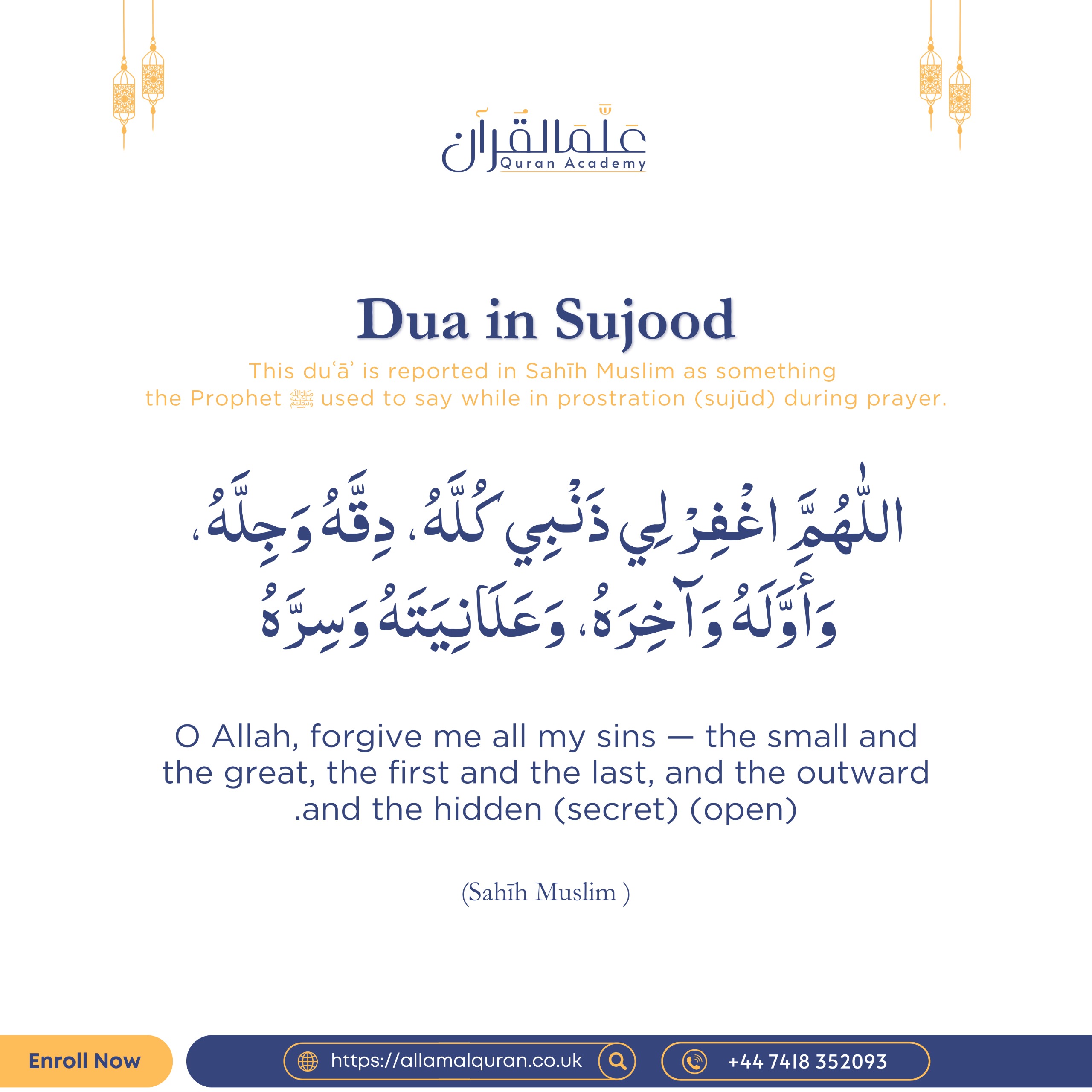
"O Allah, forgive me all my sins — the small and the great, the first and the last, and the outward and the hidden (secret)." (Sahih Muslim)
This supplication, authenticated in Sahih Muslim, represents a comprehensive approach to seeking forgiveness. The Prophet Muhammad (peace be upon him) taught this dua to be recited while in prostration, a position where a believer is closest to their Lord.
Key Insight: The dua systematically covers every possible category of sin, leaving no aspect of human transgression unaddressed. This thorough approach reflects the Islamic understanding of Allah's limitless mercy and the believer's need for comprehensive forgiveness.
The structure of the dua is methodical, addressing sins according to their:
Reciting this dua during sujood serves multiple spiritual purposes. Firstly, it acknowledges human imperfection comprehensively. Secondly, it demonstrates complete reliance on Allah's mercy. Thirdly, it trains the believer to be thorough in their spiritual accounting.
The timing during prostration is particularly significant. Islamic tradition holds that sujood is a position of maximum humility and closeness to Allah, making it an ideal moment for such a comprehensive request for forgiveness.
Teacher's Answer: The Prophet specifically recommended this dua for sujood because prostration represents the peak of humility before Allah. In this position, the believer's forehead (the highest part of the body) touches the ground, symbolizing complete submission. This physical humility creates the perfect spiritual state for seeking comprehensive forgiveness, as one acknowledges their complete dependence on Allah's mercy.
Parent's Perspective: Start by explaining the meaning in simple terms. Break down each part: "small sins" (like forgetting to say thank you), "big sins" (more serious wrongs), "first and last" (things done when younger and recently), "open and secret" (things others see and private thoughts). Practice together during family prayers. Use visual aids or simple drawings to represent the different categories. Most importantly, connect it to the concept of Allah's endless mercy so children approach it with hope rather than fear.
Teacher's Answer: The comprehensive nature serves several purposes. First, it prevents the believer from being selective in seeking forgiveness. Second, it acknowledges that humans often forget or minimize certain sins. Third, it covers sins we may not even recognize as sins due to limited understanding. By including all categories, we place our trust in Allah's complete knowledge and comprehensive mercy, rather than relying on our own incomplete self-assessment.
Parent's Perspective: While there's no strict requirement, many Islamic scholars recommend incorporating it regularly, perhaps in at least one prostration each day. This establishes consistency without becoming mechanical. For children, starting with once daily (perhaps in the Maghrib or Isha prayer) helps build the habit. The key is understanding and sincerity rather than mere repetition. As the Prophet taught various supplications for different prostrations, one can rotate through them while ensuring this comprehensive forgiveness dua remains a regular part of one's spiritual practice.
Beyond ritual prayer, this dua teaches believers to approach self-improvement comprehensively. Just as we seek forgiveness for all categories of sins, we should strive for improvement in all aspects of character: public behavior and private thoughts, small habits and major actions, past patterns and future intentions.
The dua serves as a daily reminder that spiritual development requires holistic attention. It encourages regular self-reflection across all dimensions of life, fostering a balanced spiritual development that aligns with Islamic principles of comprehensive excellence (ihsan).
Join our structured courses to learn more about authentic supplications, prayer etiquettes, and comprehensive Islamic knowledge. Our qualified instructors provide traditional knowledge with contemporary relevance.
Enroll NowContact: +44 7418 352093
Website: https://allamalquran.co.uk