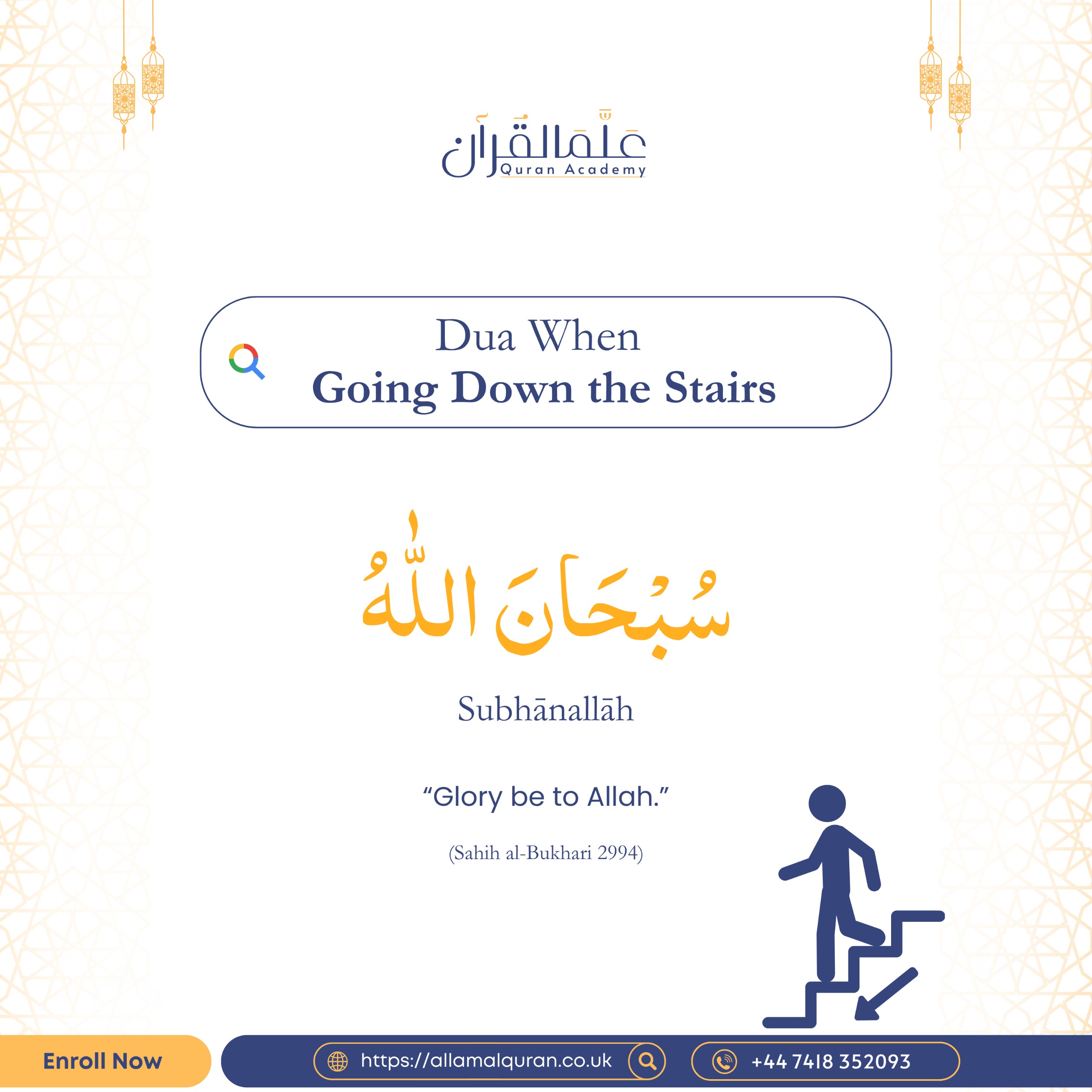
Dua When Going Down the Stairs
Turning Everyday Actions into Acts of Worship
سُبْحَانَ اللّٰهُ
Subhanallāh
"Glory be to Allah."
Source: Sahih al-Bukhari 2994
The Significance of Reciting Subhanallah When Descending
The practice of saying "Subhanallah" when going down stairs or descending from heights is a beautiful example of how Islam transforms ordinary daily activities into opportunities for remembrance of Allah. This simple yet profound supplication, authenticated in Sahih al-Bukhari, serves multiple spiritual and practical purposes in a Muslim's life.
When we recite "Subhanallah" while descending, we acknowledge Allah's perfection and transcendence, recognizing that every movement we make is by His will and permission. This practice maintains our spiritual consciousness throughout the day and turns mundane actions into acts of worship that earn divine rewards.
Every step down becomes a step closer to Allah through the remembrance of His perfection.
Benefits of This Beautiful Practice
Continuous Remembrance
Transforms routine movements into constant dhikr, keeping the heart connected to Allah throughout the day
Spiritual Mindfulness
Maintains awareness of Allah's presence in every action, no matter how small or routine
Safety and Protection
Seeks Allah's protection during potentially hazardous activities like descending stairs
Gratitude for Ability
Acknowledges Allah's gift of physical ability and coordination for movement
Common Questions About Stairs Dua
Parent: Should children be taught to say this dua for every single step or just once when starting to descend?
Teacher: The sunnah is to recite it once when beginning to descend. However, if children want to say it with each step as a learning exercise, that's perfectly fine. The key is to establish the habit of remembering Allah during this action. As they grow older, they can learn the precise practice of saying it once at the start of descent.
Parent: Is this dua only for stairs, or does it apply to other types of descending?
Teacher: While specifically mentioned for stairs in the hadith, the principle extends to any form of descending - whether it's going down a slope, stepping down from a platform, or any situation where you're moving from a higher to lower position. The wisdom of remembering Allah during descent applies broadly.
Parent: What if we forget to say the dua until we're already partway down the stairs?
Teacher: If you remember after starting descent, you should still recite it. The mercy of Allah encompasses our forgetfulness. The reward is in the intention and effort to remember Him. You can also make the intention at the top to remember Allah throughout your descent.
Parent: How can we explain the meaning of "Subhanallah" to young children in simple terms?
Teacher">Explain that "Subhanallah" means "Allah is perfect" or "Glory to Allah." You can say: "When we go down stairs, we say Subhanallah to remember that Allah made us able to walk and move safely. It's like saying thank you to Allah for taking care of us." Use simple analogies they can relate to.
Parent: Are there other similar duas for everyday activities we should teach our children?
Teacher">Yes, Islam beautifully covers daily activities with remembrance. Teach "Bismillah" before eating, "Alhamdulillah" after finishing, "MashaAllah" when admiring something, and specific duas for entering/leaving home, wearing clothes, and looking in the mirror. Start with one or two and gradually build their repertoire.
Implementing This Practice in Family Life
1
Lead by Example: Consistently recite the dua yourself when going down stairs. Children learn best by observing their parents' practices.
2
Gentle Reminders: Use positive reinforcement rather than criticism when children forget. A simple "Remember to say Subhanallah" suffices.
3
Make it Joyful: Turn it into a pleasant family tradition rather than a burdensome obligation. Smile and make eye contact when reciting together.
4
Connect to Meaning: Regularly discuss why we say this dua and what "Subhanallah" means to deepen their understanding and connection.
The Deeper Wisdom Behind This Practice
The instruction to say "Subhanallah" when descending contains profound spiritual wisdom. Physically moving downward can symbolize humility and the recognition that all elevation and status come from Allah alone. By glorifying Allah during descent, we acknowledge that true glory and majesty belong only to Him, not to any worldly position or height.
Historical Context: In the Prophet's time, stairs and elevated places were often more hazardous than modern staircases. Reciting Subhanallah served as both spiritual remembrance and a practical prayer for safety during potentially dangerous movements.
This practice also teaches us the Islamic principle of infusing our entire lives with remembrance of Allah. No action is too small or too routine to be accompanied by dhikr. This constant awareness transforms our entire existence into an act of worship.
Email Now for More Islamic Learning Resources and Daily Practice Guides