THE KA'ABA

THE KA'ABA
The Ka'aba | Sacred Architecture & Islamic Heritage

The Ka'aba: Sacred Centre of Islamic Monotheism

Exploring the historical, spiritual and architectural magnificence of the House of Allah

The Focal Point of Devotion

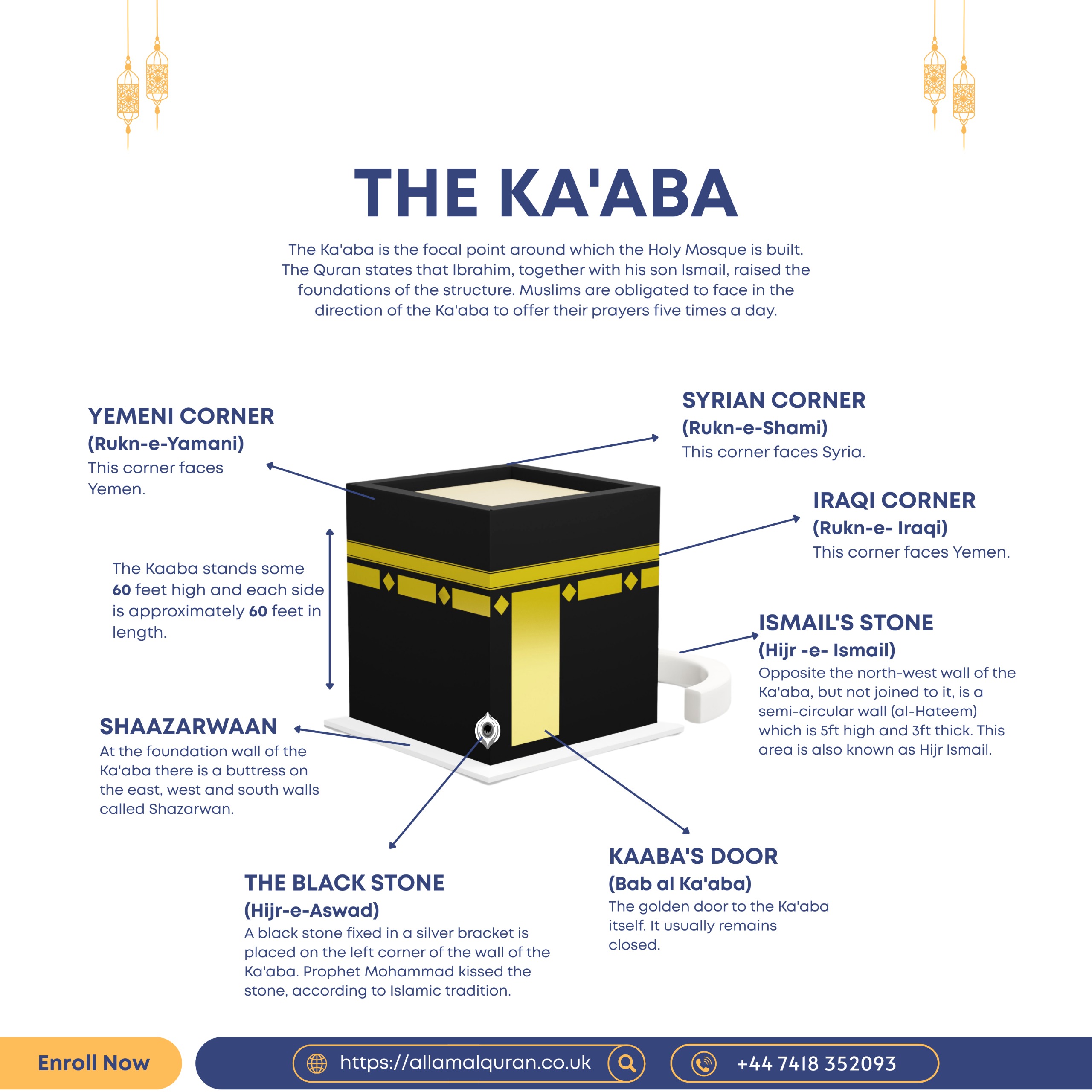
The Ka'aba, a cuboid structure draped in black silk, stands at the heart of Masjid al-Haram in Makkah, Saudi Arabia. It is the qibla (direction) that over 1.9 billion Muslims worldwide face during their five daily prayers. According to the Holy Quran, Prophet Ibrahim (Abraham) together with his son Ismail (Ishmael) raised the foundations of this blessed house as a sanctuary for the worship of One God. The Ka'aba is not merely a building; it symbolises unity, humility, and absolute submission to the Divine. Pilgrims from every corner of the globe circumambulate it during Hajj and Umrah, declaring the timeless message of tawheed. The structure has stood resilient through centuries, undergoing renovations while preserving its spiritual essence.

The Holy Mosque encloses the Ka'aba like a protective embrace. Historical records suggest that the current Ka'aba stands on the original foundations laid by Ibrahim and Ismail. The Black Stone (Hajr-e-Aswad) set into its eastern corner, and the revered station of Ibrahim (Maqam Ibrahim) remain as miraculous signs. The sacred precincts inspire devotion beyond architecture – it is the house of the most Merciful. Modern engineering now facilitates millions of worshippers, yet the Ka'aba maintains its simplicity: a perfect cube reminding believers of equality before Allah.

Black Stone

Hajr-e-Aswad, placed in a silver frame on the eastern corner. Prophet Mohammad (peace be upon him) kissed it, establishing a sunnah. It represents the covenant between Allah and humanity.

Yemeni Corner

Rukn-e-Yamani faces Yemen. It is virtuous to touch this corner during tawaf, as it follows the tradition of the Prophet and holds blessings.

Iraqi Corner

Rukn-e-Iraqi aligns with Iraq. Pilgrims often greet this corner with reverence, though no specific ritual is mandated, yet it completes the Ka'aba's architectural symmetry.

Syrian Corner

Rukn-e-Shami faces the Levant (Syria region). Each corner ties the Ka'aba's physical orientation to the wider Islamic world, unifying directions.

✧ Hijr Ismail (Ismail's Stone) & Shazarwan

Opposite the north-west wall of the Ka'aba lies a semi-circular enclosure known as al-Hateem or Hijr Ismail, 5 feet high and 3 feet thick. This area is considered part of the Ka'aba's original foundation. Pilgrims pray inside it as if they are within the House of Allah. Additionally, Shazarwan — a marble buttress protruding at the foundation — borders the east, west, and south walls, symbolising structural strength and preserving the original base of the blessed Ka'aba.

The Door of the Ka'aba (Bab al-Ka'aba)

The golden door of the Ka'aba stands elevated from the ground level, approximately 2.13 meters high. It is crafted from pure gold and adorned with intricate calligraphy. The door is opened only on specific occasions for washing and maintenance, and for dignitaries. The interior of the Ka'aba contains three wooden pillars, hanging lamps, and a table for perfumes. The walls are made of marble and limestone. The sanctity of entry is reserved, but believers direct their hearts towards it every single day. The door represents mercy and the invitation to turn towards the Creator.

Did You Know? The Ka'aba has been reconstructed multiple times throughout Islamic history. The current structure measures 11.03m x 12.86m and is approximately 13.1m in height. The kiswah (black covering) is replaced annually during Hajj.
Teachers & Parents Dialogue Interactive Q&A
Why do Muslims face the Ka'aba during prayers? +

Teacher answer: Muslims face the Ka'aba as a symbol of unity and obedience to Allah. The Quran (Surah Al-Baqarah 2:144) commands believers to turn towards the Sacred Mosque. It reminds that all worshippers, regardless of location, focus on one direction, creating harmony in the global community of Islam. Parents can explain that just like we look towards a landmark during a gathering, Muslims unite facing the house of Ibrahim.

What is the significance of the Black Stone? +

Teacher answer: The Black Stone (Hajr-e-Aswad) is a sacred stone set into the Ka'aba’s eastern corner. Islamic tradition holds that it was sent down from Paradise. Prophet Muhammad (peace be upon him) kissed it during his final pilgrimage, so Muslims revere it as a relic of prophetic practice. It does not have divine power, but it serves as a reminder of commitment. Parents can share the story that the stone was originally white and turned black due to human sins — symbolizing the need for repentance.

Is Hajr Ismail part of the Ka'aba? +

Parent response: Great question! Hijr Ismail (also called Hateem) is a semi-circular area adjacent to the Ka'aba. Historians and scholars agree that it was originally part of the Ka'aba but the Quraysh tribe could not complete the full structure. Hence, praying inside Hateem is considered equivalent to praying inside the Ka'aba. Teachers explain to students that when pilgrims perform tawaf, they walk outside this area, and it holds a special status.

What are the four corners of Ka'aba named after? +

Teacher answer: The four corners are: Rukn-e-Aswad (Black Stone Corner), Rukn-e-Iraqi (facing Iraq), Rukn-e-Shami (facing Syria/Levant), and Rukn-e-Yamani (facing Yemen). The Yemeni corner is highly recommended to touch or point towards during tawaf because Prophet Muhammad consistently did so. Each corner links the Ka'aba to different regions, signifying Islamic universalism.

Can non-Muslims enter the Ka'aba city? +

Parent-teacher answer: According to Islamic law, Makkah and specifically the area around the Holy Mosque is restricted to Muslims only. This is to preserve the sacred nature and maintain the exclusive spiritual atmosphere. Teachers can discuss that many religious sites have special access rules; the Ka'aba remains a sanctuary for believers. Non-Muslims can learn about its history through books and media, but physical entry into Makkah is not permitted.

Spiritual Architecture & Eternal Symbolism

The Ka'aba stands as a timeless focal point for over fourteen centuries. The circumambulation (tawaf) performed by millions replicates the actions of angels worshipping around the divine throne. The structure, though physically modest, holds immense metaphysical weight. The cover (Kiswah) embroidered with Quranic verses in gold thread is a breathtaking masterpiece, replaced annually on the 9th of Dhul Hijjah. Historically, various Islamic rulers expanded the Grand Mosque to accommodate increasing pilgrims, but the Ka'aba's original form—a simple cube—was always preserved.

One of the lesser-known features is the "Meezab-e-Rehmat" — the golden rain spout projecting from the roof. Rainwater cascading from it onto the Hijr Ismail area is considered blessed. Moreover, inside the Ka'aba, three wooden pillars support the roof, and the interior walls are clad with inscribed marble. Thousands of lamps illuminate the sanctuary. The floor is covered with marble. Muslims who have had the privilege to enter describe indescribable serenity. In addition, the Station of Ibrahim (Maqam Ibrahim), the stone bearing the footprints of Prophet Ibrahim, lies just in front of the Ka'aba, offering a tangible connection to prophetic history. For parents teaching children, the Ka'aba serves as a compass pointing toward unity, prayer, and global brotherhood. Through learning about the corners (Rukn), Hijr Ismail, Shazarwan base, and the golden door, young minds grasp the beauty of Islamic heritage while remaining rooted in faith. The Ka'aba is never empty; it is constantly surrounded by worshippers day and night, reflecting the perpetual devotion in Islam. Its cuboid shape, representing stability and equality, is a profound testament that the centre of Islamic life is not a relic but the concept of pure monotheism.

Modern scientific studies note that the Black Stone's composition is likely a mixture of basalt and meteorite remnants, yet its spiritual significance remains untouched. The Ka'aba continues to inspire thousands of conversions, academic research, and breathtaking artwork. Ultimately, the Ka'aba is more than stone and marble; it is the heart of the Ummah, a place where all differences dissolve and believers stand shoulder to shoulder, answering the call of Ibrahim: 'And proclaim to the people the Hajj'.

⚬ The House of Allah ⚬

© 2025 — Sacred Architecture of Islam. Based on Quranic revelation and authentic traditions. All descriptions reflect scholarly consensus.