
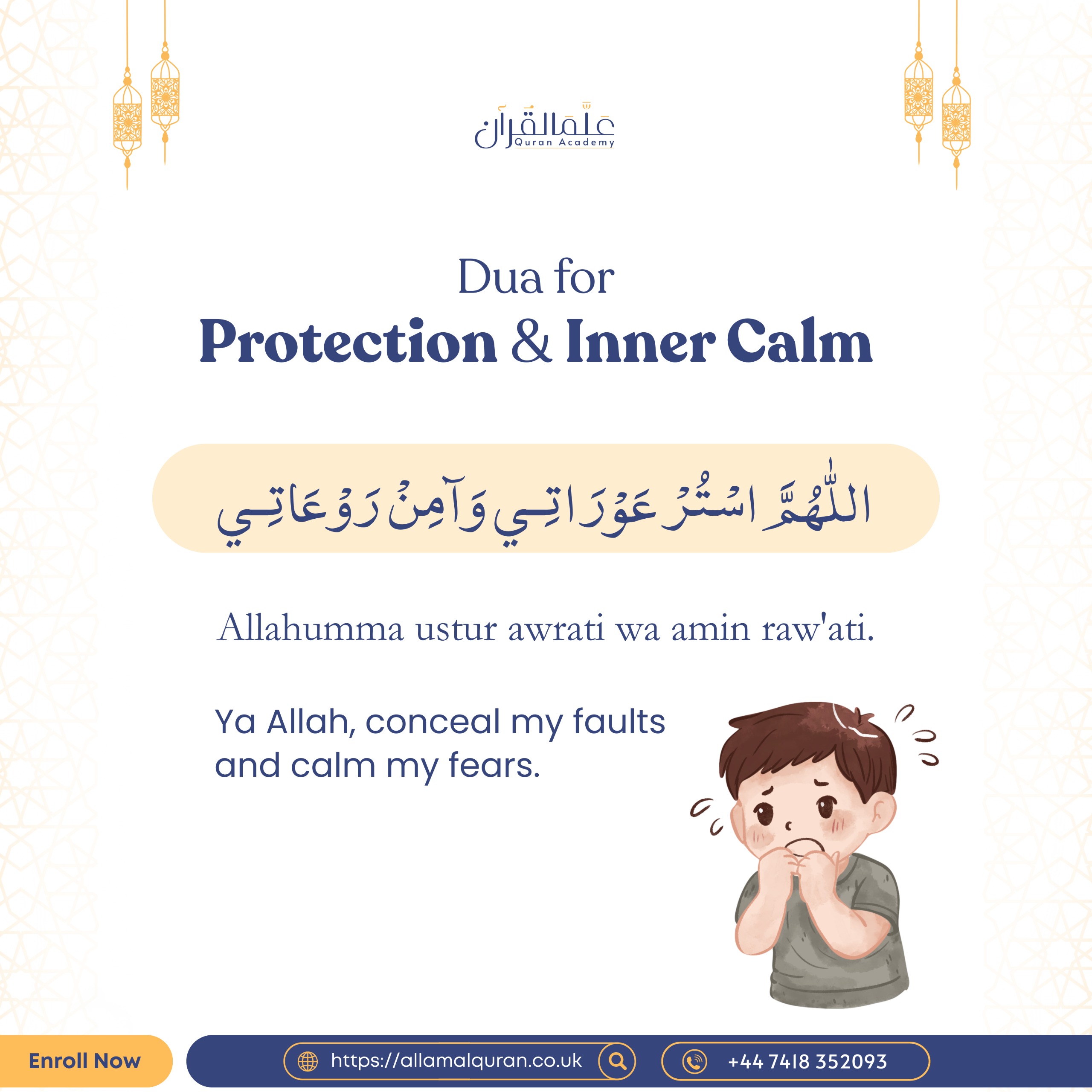
This comprehensive supplication intertwines two profound human needs: protection of honour and tranquillity of the heart. The Arabic verb "استر" (ustur) implores Allah to veil imperfections, mistakes, and private matters — a shielding that preserves dignity both in this world and the next. Simultaneously, "آمن روعاتي" (amin raw‘ati) pleads for the pacification of terror, anxiety, and sudden frights. Scholars describe it as a spiritual armour: the first part guards your social honour, the second part guards your emotional core.
"I’ve noticed your son often seems hesitant during group activities. The dua 'Allahumma ustur awrati wa amin raw‘ati' can be his nightly shield. When we ask Allah to conceal faults, children internalise that their stumbles are not for public display — this builds confidence."
"Jazakillah khair. Should I teach him the meaning or just the recitation? He's only seven."
"Both, gently. Explain that ‘Awrah’ isn’t only physical — it’s also our mistakes, embarrassing moments. When he says this dua, Allah becomes his protector. At bedtime, whisper it together. The secondary colour of trust, the gold hue of mercy, surrounds him."
"SubhanAllah. And the second part about calming fears… he has nightmares sometimes."
"Exactly — ‘amin raw‘ati’. Raw‘ah means sudden terror. This dua is a direct prescription for nocturnal fear. Recite it after the adhan or before sleeping. With consistency, his subconscious will embed the phrase, and the brain’s amygdala response softens."
"Can we recite it for someone who is ill or distressed?"
"Absolutely. The Prophet ﷺ taught us to make dua for others in absence. Visualise the person and say: Allahumma ustur awratahu wa amin raw‘atahu. It becomes a gift of unseen protection."
This comprehensive supplication is traced to the Prophet's sunnah, recorded in Abu Dawud and authenticated by Al-Albani. It was often recited during times of distress and before sleep. Its wording is concise yet covers both outward and inward safety.
Recommended after fajr and maghrib, before travelling, or when feeling exposed/vulnerable. Many scholars emphasise it during financial hardship or when one fears slander. The phrase ‘ustur awrati’ also relates to modesty in dress and behaviour.
Both grant tawakkul, but this dua specifically isolates the fear of exposure and sudden terror. It is unique in combining social-spiritual safety (starl) with emotional-physiological calm (amn). It’s like a targeted mercy for shame and panic.
press the button — reflect on how this dua resonates today
The dua of concealment & serenity — a timeless prophetic therapy. share the light.