
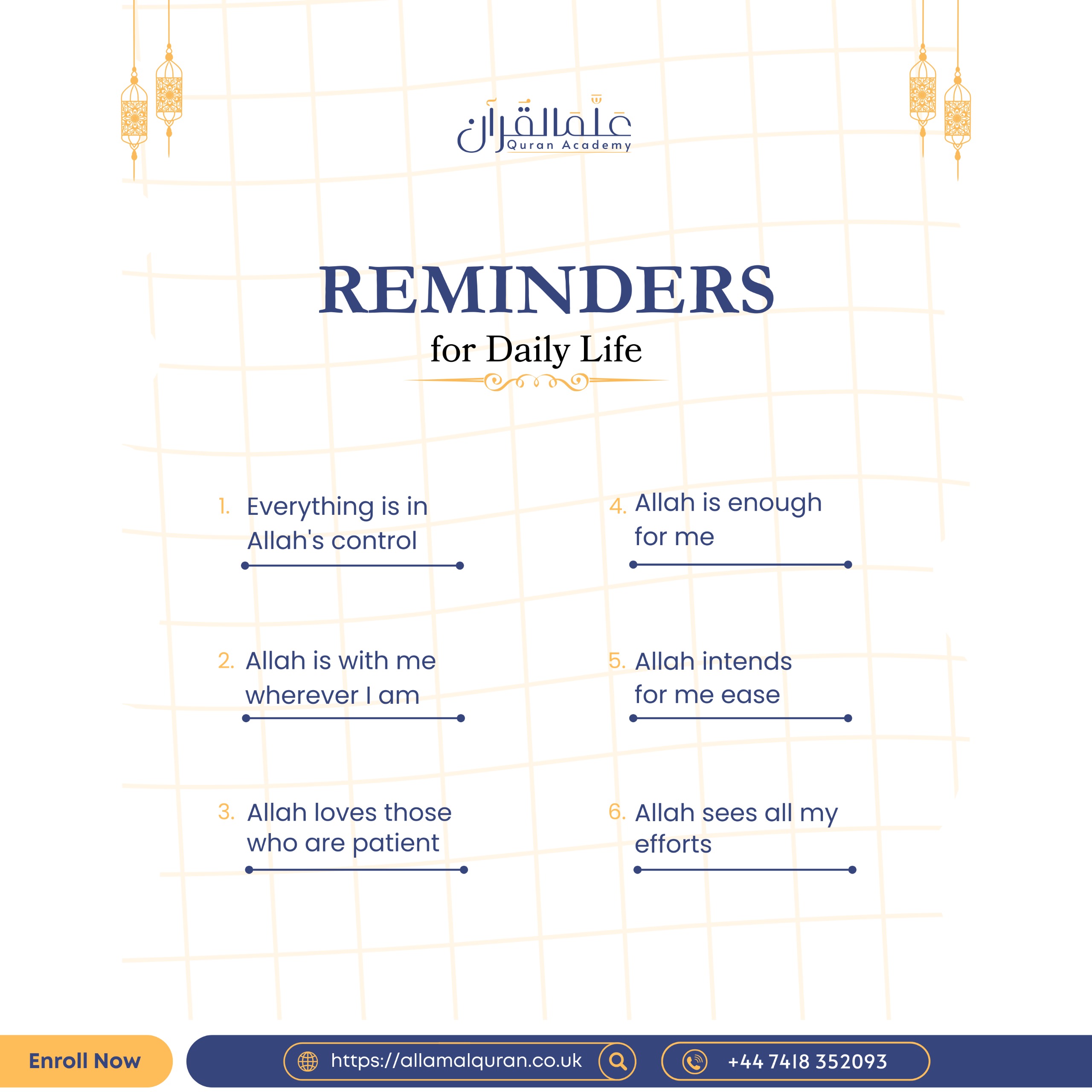
Every outcome, every door, every delay passes through Divine command. This reminder repositions anxiety into surrender. When we internalize that nothing moves outside His control, we stop wrestling with creation and rest in the Creator's wisdom.
Loneliness dissolves when we realize the Creator of galaxies walks with us through the grocery store, the boardroom, the hospital corridor. His presence is not abstract — it is the most intimate companionship a soul can experience.
Patience isn't passive waiting — it's active perseverance while maintaining beautiful composure. This reminder reframes trials as love letters. Difficulty becomes a distinction; the one who endures is the one whom Allah singles out for His affection.
When human support fails, when validation doesn't come, when resources run dry — this truth activates. Allah being "enough" means no addition is necessary and no absence can diminish. Complete. Perfect. Sufficient.
Hardship is not the destination; it's the passage. The Divine intention beneath every decree is relief, not punishment. This reminder transforms how we read our circumstances — looking for the mercy hidden within the trial.
No sincere effort is anonymous. The dua whispered at dawn, the temptation resisted, the work done with integrity — the Highest Witness observes it all. This reminder validates every invisible struggle.
My daughter is 9 and recently asked, "If Allah controls everything, why do we have to make dua? Doesn't He already know what He's going to do?" I struggled to explain the balance between Divine decree and our supplication.
What a profound question from her! I explain it to my students using a parent-child analogy: You know your child will ask for water eventually, but you still want them to ask you because the asking itself builds your relationship. Allah commands dua not to inform Him of our needs — He knows them already — but to keep our hearts continuously connected to Him. The decree changes BECAUSE of the dua; it's not that Allah didn't know, but that He created the dua as the means to the outcome. Her question shows she's really thinking deeply about tawheed.
My son, who's 12, gets very frustrated when he studies hard but doesn't get the grades he hoped for. How do I help him connect with the reminder that "Allah sees all my efforts" without dismissing his disappointment?
This is such a common struggle. I tell my students: Your grade is on paper, but your effort is in Allah's book. Which record has permanence? We validate the disappointment — it's real, and even Prophet Yaqub wept until he lost his sight over Yusuf. But we help them shift their metric of success from outcome to output. Ask him: Did you prepare? Did you try your best? Then you succeeded in Allah's sight, regardless of the grade. The grade is dunya; the effort is for eternity. This reframing takes time but builds extraordinary resilience.
How can I help my teenager feel that "Allah is with me" when she's the only Muslim in her friend group and feels invisible during their conversations?
I'd encourage you to help her see that feeling invisible to people can be a veil lifted — she's not unseen, she's witnessed by a higher audience. The Prophet ﷺ was alone in the cave of Hira, but he was with Jibril, with Allah. I give my students this exercise: When you feel alone, place your hand over your heart, close your eyes, and say "Allahu Ma'ana" — Allah is with us. Physically feel it. Also, connect her with Muslim youth spaces where her identity is reflected. She needs both: the internal conviction AND external community.
These six statements are not mere affirmations — they are paradigms. They restructure how we interpret reality. The professional who internalizes "Allah sees my efforts" works with integrity regardless of supervision. The parent who believes "Allah intends ease" parents with mercy, not harshness. The patient one knows they are loved, not punished. This is the architecture of a heart at peace.