
A Comprehensive Guide to Perfecting Your Prayer According to Quran and Sunnah
Salah is the cornerstone of Islamic worship, a direct connection between the believer and Allah. However, even with the best intentions, many Muslims unknowingly make errors in their prayer that can affect its validity or perfection. This article details seven common mistakes observed in Salah, explains why they matter, and provides authentic corrections based on Islamic teachings.
Understanding these mistakes is crucial for every Muslim striving to perfect their worship. Whether you're a new Muslim, a parent teaching children, or someone seeking to refine your prayer, this guide will help you identify and correct these common errors.
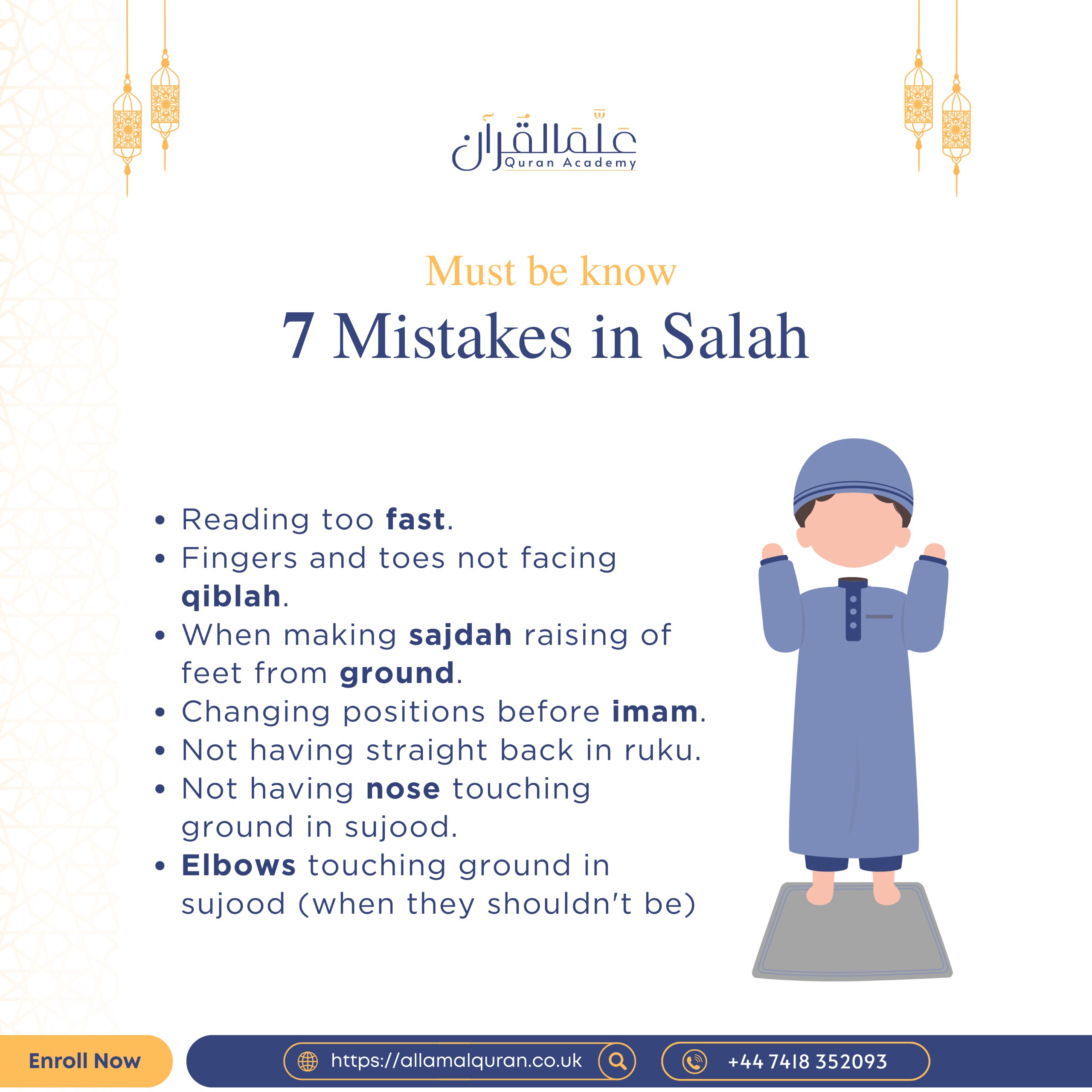
Rushing through recitations without proper pronunciation, Tajweed rules, or contemplation defeats the purpose of connecting with Allah's words. Each letter must be given its due right with proper articulation and pauses.
During Salah, fingers and toes should face the Qiblah. This subtle yet important aspect demonstrates complete submission and unity in worship direction, aligning every part of the body toward the Kaaba.
In prostration, both feet should remain flat on the ground with toes pointing toward Qiblah. Raising one or both feet reduces stability and contradicts the complete submission that Sajdah represents.
In congregational prayer, followers must not precede the Imam in movements. This disrupts the unity of the congregation and goes against the command to follow the Imam's lead in every position change.
During Ruku (bowing), the back must be straight and parallel to the ground, forming a 90-degree angle. A curved or improperly aligned back affects the prayer's validity as it doesn't fulfill the proper bowing position.
In prostration, seven body parts must touch the ground, including the nose. Leaving the nose elevated contradicts the complete humility required in Sujood and affects the prayer's completeness according to many scholars.
During prostration, elbows should be raised off the ground and away from the sides. Allowing elbows to touch the ground or press against the body resembles the posture of animals and reduces the proper form of submission.
Correcting these mistakes requires conscious effort, knowledge, and consistent practice. Begin by focusing on one mistake at a time during your prayers. For recitation speed, practice reading Quran outside Salah with proper Tajweed. For physical positions, consider praying in front of a mirror occasionally or asking a knowledgeable person to observe and correct your posture.
Remember that Salah is about both outward form and inward presence. While correcting physical mistakes, also work on your concentration (Khushoo). The Prophet Muhammad (peace be upon him) said: "The first thing for which a person will be brought to account on the Day of Resurrection will be his prayer. If it is sound, he will have succeeded; if it is defective, he will have failed." (At-Tirmidhi)
Regular self-assessment and seeking knowledge from authentic sources are essential. Consider joining a Salah correction class or seeking guidance from a qualified teacher who can provide personalized feedback.
This depends on the mistake and the scholarly opinion. Some mistakes, like not facing Qiblah when possible, invalidate Salah. Others, like rushing recitation, make the prayer imperfect but not necessarily invalid. However, we should strive for perfection in all aspects of worship. Consulting with a knowledgeable scholar about specific concerns is recommended.
Parents should lead by example with proper Salah themselves. Make prayer correction a positive learning experience, not a criticism. Use visual aids, gentle reminders, and age-appropriate explanations. Consider enrolling children in Islamic classes where they learn Salah with peers. Praise their efforts and progress to encourage consistency.
If the mistake was due to ignorance and you've now learned the correct method, you don't need to repeat past prayers according to most scholars. Allah is Most Merciful and understands sincere ignorance. However, you should immediately begin praying correctly and make sincere repentance for any shortcomings. Continue seeking knowledge to improve your worship.
Yes, there are some differences in scholarly opinions regarding certain aspects of Salah. For example, the requirement for the nose to touch the ground during Sujood has some variation in interpretation. It's important to follow a consistent school of thought or seek guidance from qualified scholars who can explain these differences and help you follow an authentic, evidence-based approach.
This is a common challenge. The key is gradual improvement. Don't try to correct everything at once. Focus on one aspect for a week or two until it becomes natural, then move to the next. With time, the correct form becomes habitual, allowing you to concentrate on the spiritual aspects. Remember that Allah sees your effort and rewards the struggle to improve your worship.
Join our specialized Salah correction courses designed for adults and children. Our qualified teachers provide personalized feedback and practical demonstrations to help you perfect every aspect of your prayer.
Enroll Now for Salah Correction CourseVisit our website: allamalquran.co.uk
Contact us: +44 7418 352093