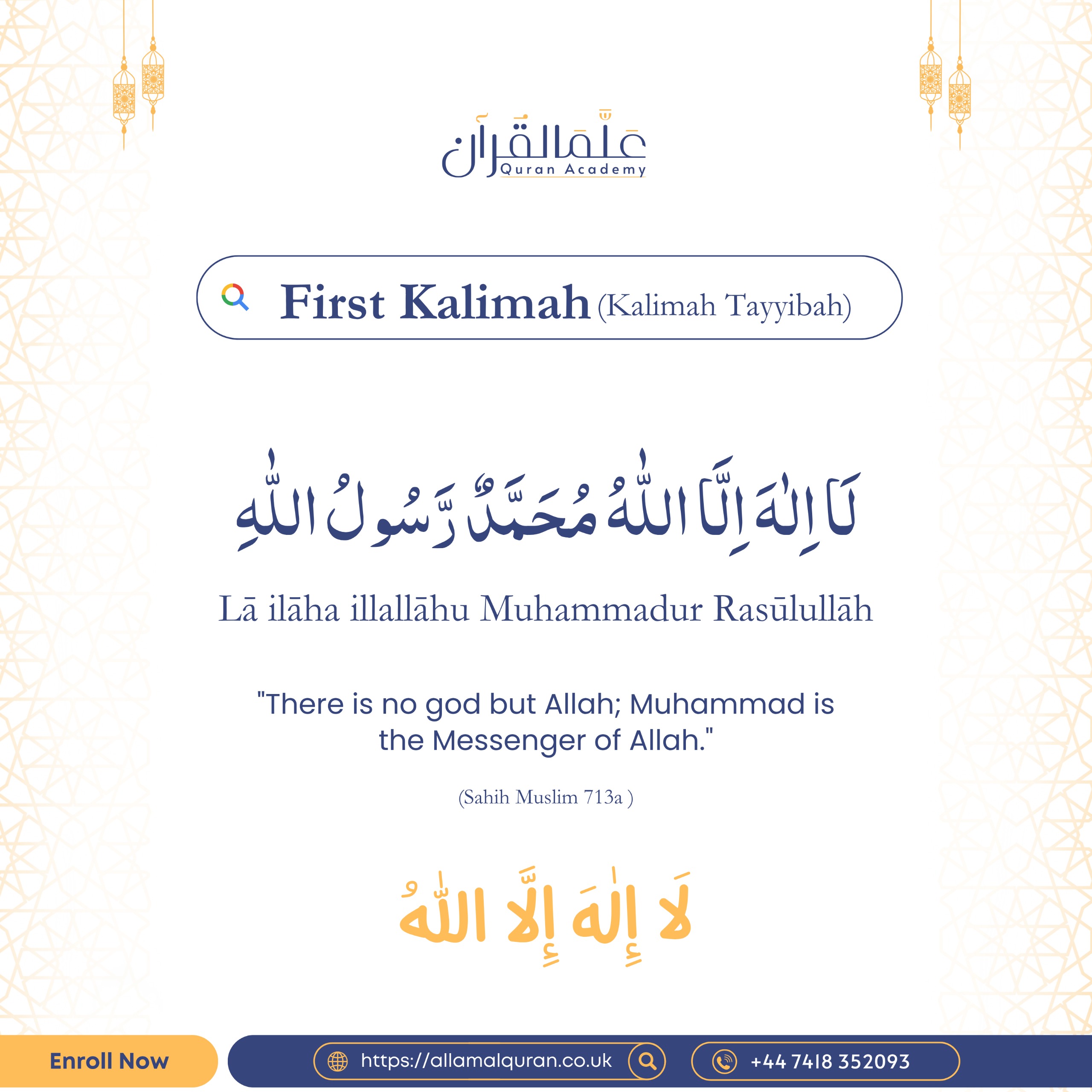
First Kalimah (Kalimah Tayyibah)
The Foundation of Islamic Faith and Declaration of Monotheism
لَا اِلٰهَ اِلَّا اللّٰهُ مُحَمَّدٌ رَّسُولُ اللّٰهِ
La ilāha illallāhu Muhammadur Rasūlullāh
"There is no god but Allah; Muhammad is the Messenger of Allah."
Source: Sahih Muslim 713a
The Profound Significance of Kalimah Tayyibah
The First Kalimah, known as Kalimah Tayyibah (the Pure Word), represents the fundamental declaration of faith in Islam. This powerful statement serves as the foundation of Islamic monotheism and the entry point into the religion of Islam. It encapsulates the core beliefs that distinguish Muslims from other faith traditions.
When a person sincerely recites and believes in the Kalimah Tayyibah, they enter the fold of Islam, acknowledging the absolute oneness of Allah and accepting Prophet Muhammad (PBUH) as the final messenger. This declaration transforms one's spiritual identity and establishes the basis for all subsequent Islamic beliefs and practices.
The Kalimah Tayyibah is not merely words to be recited, but a profound commitment that shapes a Muslim's entire worldview and way of life.
Benefits and Virtues of Kalimah Tayyibah
Entry to Islam
Serves as the formal declaration that brings a person into the fold of Islam and establishes their Muslim identity
Spiritual Purification
Cleanses the heart from shirk (associating partners with Allah) and establishes pure monotheism
Eternal Salvation
Provides the foundation for salvation in the Hereafter when accompanied by righteous actions
Daily Guidance
Serves as a constant reminder of our purpose in life and guides our decisions and actions
The Two Pillars of Faith
Kalimah Tayyibah consists of two essential components: Tawheed (Oneness of Allah) and Risalah (Prophethood of Muhammad). Both are equally crucial for complete Islamic faith - one cannot be accepted without the other.
Common Questions About Kalimah Tayyibah
Parent: At what age should we start teaching our children the Kalimah Tayyibah?
Teacher: Children should be introduced to the Kalimah as soon as they begin speaking, typically around 2-3 years old. Start with simple repetition and gradually explain its meaning as they grow older. The Prophet Muhammad (PBUH) emphasized teaching children the declaration of faith from a young age, making it their first introduction to Islamic beliefs.
Parent: How can we explain the concept of Tawheed to young children?
Teacher">Explain Tawheed in simple terms: "There is only one God - Allah. He created everything - the sun, moon, stars, animals, and us. We only worship Allah, nobody else." Use visual aids and everyday examples from nature to help them understand Allah's oneness and uniqueness in creation and worship.
Parent: Is reciting the Kalimah once in a lifetime sufficient, or should we recite it regularly?
Teacher">While declaring the Kalimah once with understanding and conviction is sufficient to enter Islam, regular recitation is highly recommended. The Prophet Muhammad (PBUH) encouraged frequent remembrance of the Kalimah as it reinforces faith, earns rewards, and protects from shirk. Many Muslims recite it during daily adhkar (remembrances).
Parent: What is the difference between Kalimah Tayyibah and Shahadah?
Teacher">Kalimah Tayyibah and Shahadah refer to the same declaration of faith. "Kalimah" means "word" and "Tayyibah" means "pure," while "Shahadah" means "testimony." Both terms are used interchangeably to describe the fundamental Islamic declaration of faith in Allah's oneness and Muhammad's prophethood.
Parent: How can we make learning the Kalimah engaging for children?
Teacher">Use creative methods like nasheeds (Islamic songs) that include the Kalimah, colorful flashcards with Arabic text and translation, storytelling about the importance of Tawheed, and positive reinforcement when they recite it correctly. Make it a joyful part of their daily routine rather than a chore.
Teaching Kalimah Tayyibah to Children
1
Early Introduction: Begin teaching the Kalimah as one of the first phrases children learn, even before they fully understand its meaning.
2
Progressive Understanding: As children grow, gradually explain the meaning of each part - first the concept of one God, then the role of Prophet Muhammad (PBUH).
3
Daily Practice: Incorporate the Kalimah into daily routines - upon waking, before sleeping, and during family Islamic learning sessions.
4
Living the Kalimah: Demonstrate how the Kalimah influences our actions - praying only to Allah, following the Prophet's teachings, and making decisions based on Islamic principles.
Deep Meaning of Each Component
"La ilaha illallah" - There is no god but Allah
This first part establishes Tawheed (monotheism) and includes:
Tawheed ar-Rububiyyah: Believing Allah is the sole Creator, Sustainer, and Master of the universe
Tawheed al-Uluhiyyah: Worshipping Allah alone without any partners
Tawheed al-Asma was-Sifat: Accepting Allah's names and attributes as described in Quran and Sunnah
"Muhammadur Rasulullah" - Muhammad is the Messenger of Allah
This second part establishes acceptance of Prophet Muhammad's (PBUH) messengership:
Belief in his message: Accepting the Quran as divine revelation
Following his example: Implementing the Sunnah in daily life
Loving the Prophet: Having genuine love and respect for Allah's final messenger
Email Now for Comprehensive Islamic Learning Resources and Faith Foundation Guides